
Do you remember teaching the 5-Step Writing Process? At our school, kids would sometimes move their clip on a poster to indicate their current step. Clips would move linearly down the poster: prewrite, draft, revise, edit, and then publish. In other classrooms, everyone would prewrite on Monday, everyone would draft on Tuesday,everyone would revise on Wednesday…
Today, we know writing is a recursive, sometimes messy process, and we know it varies from writer to writer. We all approach the task of writing differently. There is no “one writing process.” As we enter into our final quarter of the school year, I thought we should begin reflecting on our lives as writers. To start, we would reflect on our own process. I sat with a group of 6th graders, and we talked about what the process looks like for each of us. Here is what I told a group of 6th graders about my own process:
Here is a transcript: I find that a lot of my drafting actually takes place in my head. Once I have an idea, I spend a long time just envisioning the final product. I think about what I’m writing in the shower and when I’m driving and when I’m eating lunch. I think about the actual words I will write, how will I start, what the title will be, what kind of structure I might use. I guess I kind of write it in my head. Then, when I have time to do the actual writing, I just open up a blank page on my computer and start typing. This part, the writing part, is actually rather easy for me because I already have a really good idea what I want to say. So, for me, I feel like I have two drafting processes: an internal and an external. I do a whole bunch of revising while I draft on the computer – I backspace, delete, and add words while I’m typing. This feels like drafting and revising simultaneously. After I type the whole piece, I usually walk away from it for a while. I feel like I need some space in between the draft and the big revision, like I need to look at it later with fresh eyes. I’ll come back to the piece later that day or the next and reread it. Here, I’ll make some major revisions and edit – all at one time. I’ll look for grammatical or spelling errors. I’ll correct sentence structure that doesn’t sound right. I usually read it aloud to myself at this point, and that is when I might take out a sentence or add a few words or sometimes even rewrite whole paragraphs. Depending on the piece, I might have my husband help me edit and revise at this time. Right up until the time I hit publish, I’ll hop in and out of the document and tweak it until the deadline comes. If I didn’t have a deadline, I think I might live in a constant state of revision. It’s very rare that I ever feel completely done.
If I were going to represent my process graphically, it might look like this:

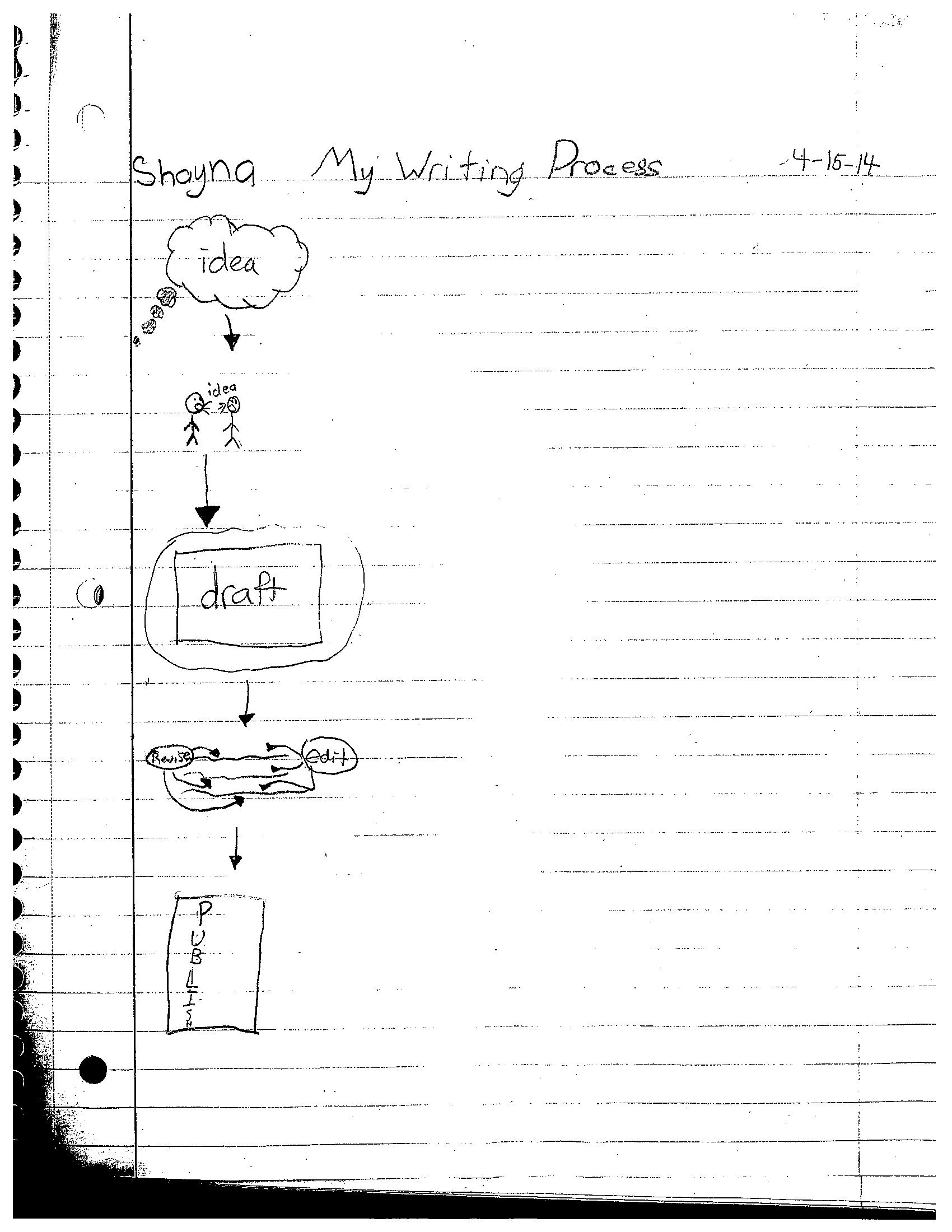
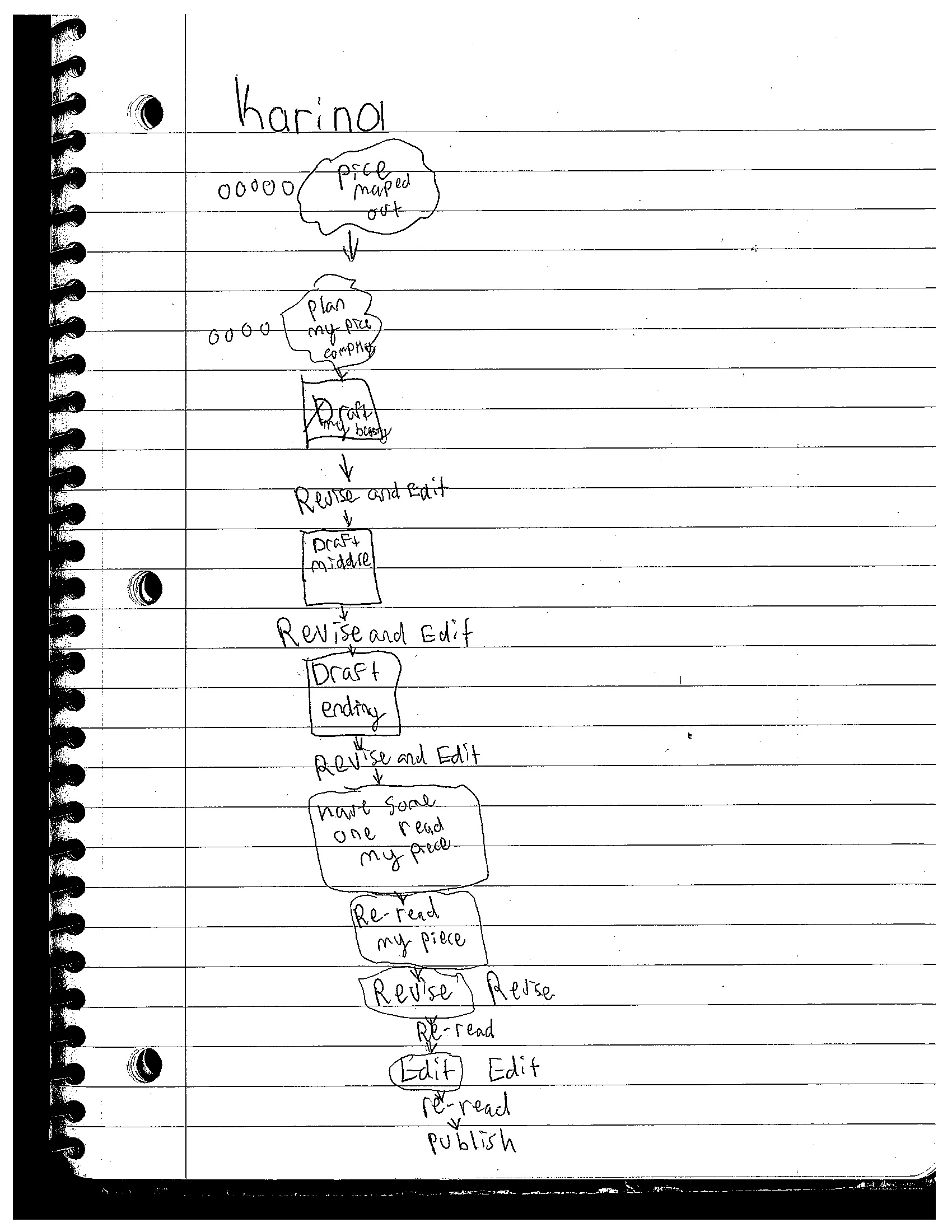
Other students explained their writing process to a friend.
Discover more from TWO WRITING TEACHERS
Subscribe to get the latest posts sent to your email.


I too saw myself in your process. I think I have been composing texts for years in my head and only recently have been putting them on paper. So the process of head composition is just what I do.
And of course! Why hadn’t I thought about this with my students. I don’t know if they are thinking about what they might write before they walk in the room and if they don’t how hard this makes it for them. It seems we need to teach into this thinking work. Make this thinking something they are doing as they brush their teeth, sit in the car, right before they go to sleep. Really what a great way to engage their minds and then bring it all to the writing process. Thank you so much for this post!
LikeLike
This is a really important conversation to have with students, Dana. I loved hearing about your process AND seeing the visual where revision is quite prominent. (Speaking of revision, you might want to check this out: http://www.heinemann.com/blog/post/2014/04/08/Heinemann-Author-Q-A-Series-Georgia-Heard-Part-1.aspx.)
I look forward to continuing the conversation about writing process by hearing more about it from you and your students.
LikeLike
I think about it a lot, rehearse it out loud (in the shower and in the car) and then write it when I feel like I am ready to burst and it has to come out. Then there is a lot of revision. I want to ask my fourth graders about this. Since we are still teaching a fairly linear process at our school, (although the process line in my class has little revision bubbles all over the place from the very first step on…) I imagine they will say that is their process. But I want to find out. Cool idea! I want to think about how to make the various processes visual for them.
LikeLike
Thanks for sharing this. I also draft and revise in my head in the shower, in the car, and while waiting for “anything.” Is that a “pre-writing” strategy? It’s less about that answer and more about “how” do I work through my process? And when does my process change – high stakes purpose???
So great to see that your students do not feel constrained by a “cookie cutter” process!
LikeLike
I love how you modeled the lesson before asking your students to do it. Thinking out loud and modeling is so important – but (unfortunately), not always implemented.
LikeLike
This is SO MUCH like my writing process! I often say that I let the “back of my head” do most of the initial drafting.
LikeLike
I saw myself so clearly in your process, Dana! I also do a lot of inside my head thinking and planning before I write. Making students aware of what works for them is so important – reflection at its best!
LikeLike