I was conferring with Kevin, an 8th grade writer, as he was drafting his memoir about a recent trip to Mississippi. He read aloud this sentence from his draft:

The idea of description and detail has been on my mind since that conference with Kevin. I looked at my own writing, and I looked at the writing of some of my favorite authors of memoir and narrative. I asked my colleagues. Here is some of my thinking, which continues to evolve. How do writers of memoir use details?
Writers of memoir use details to introduce a new scene.
In another section of Kevin’s memoir, he leaves the airport after a long flight, and he arrives at his aunt’s house. Here, he might stop to describe his aunt’s house with detail, to help orient the reader to the new scene. Similar to letting our eyes adjust after coming indoors on a bright day, sometimes we need to give our readers the chance to adjust to a new place.
Writers of memoir use details to slow down the pace of the story.
When we are writing memoir, sometimes we wish to carry the reader quickly along a path of events, and sometimes we want to linger a bit longer in certain places. For example, in a memoir I wrote about my family’s annual day of baking, I wanted to slow the reader down a bit as my family and I waited for the apple strudels to bake in the oven. I stopped to describe the warm coffee we drank, the blankets wrapped around our legs, the cozy couches. I wanted the reader to linger here, to feel the wait. A bit of descriptive writing helped me slow the pacing of my memoir.
Writers of memoir use details to direct the reader’s mind to certain images.
We are always telling our students to create a movie in the mind of their reader. Description and details help to direct the reader’s eye towards certain parts of the movie. For example, in Judy Brinckloe’s picture book, Fireflies!, the main character runs down to the cellar to find a jar. Judy writes, “The jars were dusty, and I polished one clean on my shirt.” See how that small description directs the reader’s eye to “see” the jars for just a moment? Sometimes, details are the director of the movie.
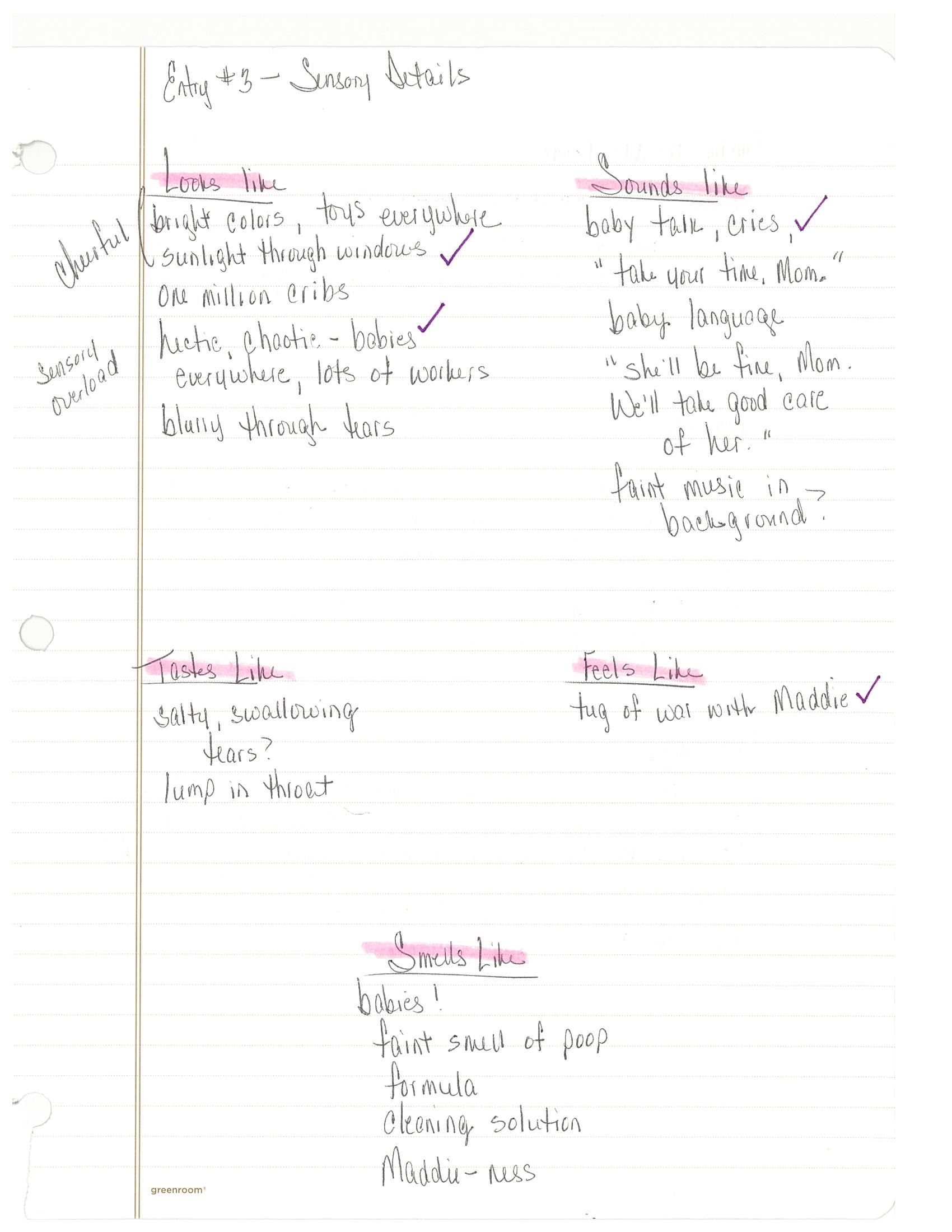
I am thankful to Kevin for making me pause and think about descriptive details. We often have our students write an entry in their Writer’s Notebook where they think about the details. Here is my entry where I wrote about the sensory images that came to mind in my memoir about my daughter’s daycare:
Discover more from TWO WRITING TEACHERS
Subscribe to get the latest posts sent to your email.


Bravo to Kevin for speaking up and questioning what he was working at. Bravo to you for being that adult in Kevin’s life that encourages him (and I’m sure others, as well) to question. Then, you not only listened to him, but you looked at your own writing and others’ writing and really learned from him. We can ALL learn from this beautiful situation.
LikeLike
I’m thankful you have drawn my attention to this! I have never conveyed the direct connection between descriptive details and pacing with my students. light bulb! Of course we work extensively with details and description, but often the absence of details is equally important and speaks volumes on its own. What a great point to help students move through a piece.
LikeLike