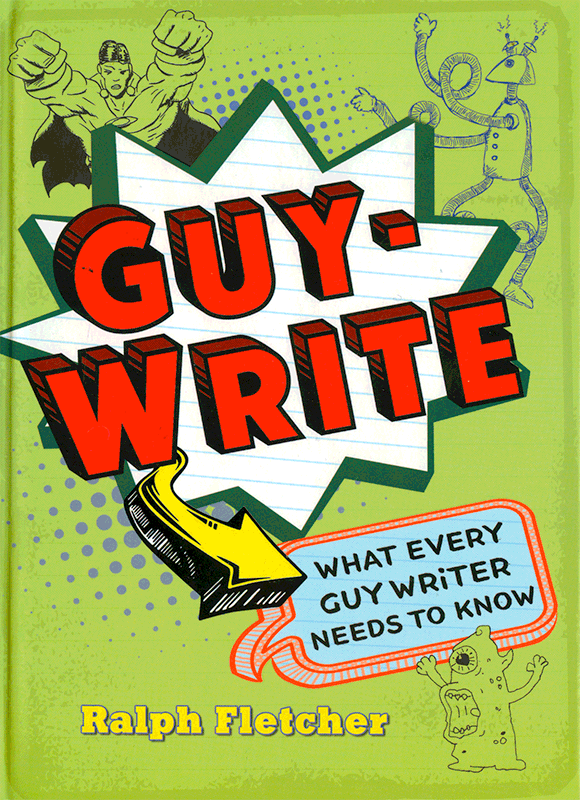
Anyone who has ever read Ralph Fletcher’s books for young writers (e.g., A Writer’s Notebook, How Writers Work, Live Writing), will find his newest book, Guy-Write: What Every Gut Writer Needs to Know (Holt), to be a welcome addition to a classroom’s writing center. Fletcher writes this book for boys who love to write who may feel, if any of their friends, share their passion.
Ralph talks directly to boys about writing on the pages of his book. He levels with them, telling them how to write without upsetting their teacher. He explains how to be funny. He helps readers understand how to create strong, emotional writing. He even has an entire chapter about how to keep a writer’s notebook in the service of becoming a better writer. All this time he’s talking directly to his reader, a guy writer.
Upon finishing Guy-Write, I had some questions for Ralph. I’m sure you’ll agree that his answers are thoughtful and thorough. I hope they’re useful to you as you work with the male writers in your class. (To that end, if you haven’t read it yet, then pick up a copy of Boy Writers: Reclaiming Their Voices. That’s Ralph’s book for teachers about nurturing the male writers in your classroom.)
Stacey: How can we best work with guy writers in a school setting?
Ralph: I wrestled with this question in BOY WRITERS (Stenhouse). This big, sprawling issue is hard to crystallize into a few pithy nuggets. However, let me share a few the principles I’ve come to believe in. I think with boy writers we need to go for engagement first—the quality will come later. If they’re not engaged, if they feel discouraged, overwhelmed, turned off—you’re sunk.
With boys writers I think it’s important that educators are willing to walk a mile in their shoes, to understand school from a boy’s point of view, as they might experience it. Schools are one of the few places left where we as teachers encounter “the other”—different ethnic groups, other social classes, ages, sexual orientation, and of course a different gender. Let me suggest how this might play out in a writing classroom. Let’s say a teacher has always emphasized memoir writing—and her male students typically don’t like that. In this case, she might look at her curricular calendar and include genres that boys might find more appealing: humor, graphica, sports commentary, horror, for example.
Stacey: I’ve always had the stomach to listen to disgusting stories, but rarely write about the disgusting things that happen in life. However, your chapter “Riding the Vomit Comet” inspired me to take on some gross writing. You mentioned to your male readers that they shouldn’t gross out readers unless it serves a purpose in the story. How do you think teachers can nurture (guy) writers to write about gross things in a meaningful way
Ralph: We might ask boy writers to consider the question: why do you want to include this gross part? What purpose does it serve? But grossing people out in a story may not be “meaningful” as you or I may define the word. A boy writer may want to include a gross part to create a mood, to deepen a character, or just because it’s funny. For instance, consider an example not from writing but from the movies. There’s a scene in Along Comes Polly where Ben Stiller plays basketball and ends up guarding a sweaty, hairy guy. There are slow-motions sections of him getting his face rubbed into this guy’s chest. Even now they make me shudder. Why is this included? True, this scene emphasizes the prissy/careful of the Ben Stiller character. But let’s face it—the main reason is that it’s laugh-aloud funny!
Stacey: On a related note, you write about using blood effectively in one’s writing (pg. 40). Would you boil down the ways to create bloody scenes for our readers, who are teachers, so they can use these ideas as a means to talk with students about gory scenes?
Ralph: In Guy-Write I explore this issue in a chapter titled Writes of Blood, Battle and Gore. Blood is real. People get hurt. Hockey players get into fights and have their faces stitched up. And there’s plenty of blood in ordinary life. When I was a kid, a neighborhood dog attacked and ate most of our chickens, leaving behind a horrific scene. After a deer has been shot, it must be gutted and dressed. (This task is not for the faint of heart!) There’s no reason our writers can write about this, so long as they treat blood in a respectful, matter-of-fact way.
I suggest that teachers use mentor texts that model effective but not over-the-top use of blood. High school students might look at “The Ball-Turret Gunner,” for instance. Middle school kids could look at the scene where Brian finds the body of the dead pilot in Hatchet. There are gory descriptions of warfare in the Redwall Series by Brian Jacques. Students might look at Neil Gaiman’s The Graveyard Book, and do a close reading of the first few pages (the very first chapter). We should also show them examples where bloodshed is handled in a more subtle way. It’s illuminating to see how little blood can be found in a story like “The Tell-Tale Heart” by Edgar Allen Poe.
Stacey: Many of the boys I’ve taught have written personal narratives about baseball, basketball, or soccer. The chapter on sports writing really made me think about the way young writers can portray themselves or their teammates in writing by thinking of them as people first. How can this concept lift the level of the personal narratives students write in the fall? Also, what are some teaching points teachers can use when they confer with boys who are writing personal narratives about sports?
Ralph: Lucy Calkins likes to say that when a boy and his father climb a mountain the real story is not what happens to them, it’s what happens between them. Isn’t that true about strong sports writing?
I don’t want to be formulaic, but I do think a good narrative includes three pillars—place, plot, and characters. Boy writing in this genre is typically strong on plot, but light on the other two. In my book I give some good examples of young writers can beef up characters, and more fully describe the place/setting where the action takes place.
One caveat: writing teachers should have high standards, but at the same time we should be realistic. I believe that most young writers will do a lot of bad writing along the way. That’s just a fact. It’s not all going to be great. Whenever kids try a new skill, strategy, or genre, we should try to value the attempt at least as much as the mastery.
Stacey: Your discussion of drawing as an entry point into writing (pg. 90) really seeks to help guy writers that it’s okay to draw in service of writing. How can teachers nurture the boys who prefer to get going with their writing by drawing?
Ralph: Let them draw first. Drawing may open up a part of the brain that’s different from language, but nonetheless rich. Primary teachers let students draw, but drawing is frowned upon in the middle and upper grades. Why? I think teachers may be afraid of opening Pandora’s Box: if we let them draw, won’t they only draw? My experience is that boys will move from drawing to writing. You may want to provide commonsense limits–the first ten or fifteen minutes for drawing–but I haven’t found this to be a big problem.
Stacey: Towards the end of your book you talk about developing routines and rituals for writing. One thing you talk about is a “writing place.” I blogged a bit about creating spaces to write, but would love for you to say more about ways teachers can help boys develop their own writing places outside of the classroom.
Ralph: I suggest that we ask students to share the place where he/she feels most at home. But I also I think it’s important that our students feel “at home” inside our classrooms. This is easy to say, but it’s a profound idea if we truly embrace it.
For years now I have have had a nagging idea that our writing workshops are too static for most boy writers. I was the kind of student who can write at a quiet desk, but lots of boys need to feel like they can move around during their process. Think about it: Hemingway stood up while he wrote! No, we don’t want chaos, but I think we should to invite kids to use the class as they see fit during the writing time. Let them sprawl on the floor if that’s where they feel most comfortable. Let them rope off a corner. Let them see the writing classroom as a place where they can be themselves while they write.
Stacey: I loved the pages about “polishing before you go public.” I especially loved reminder to boys that their writing can be gifted as presents. How do you think teachers can use this in the classroom?
Ralph: The late great Don Graves warned teachers about the dangers of conformity and orthodoxy. The writing process was once a fresh, new, quasi-radical idea, but then the publishers got hold of it, and printed glossy posters of The Writing Process, and it almost became formulaic. Don’s warning is worth remembering today. Instead of teaching students the writing process, I think we should help each student find a process that works for him or her.
That also holds true for publishing student writing. There shouldn’t be just one or two ways for kids to publish. Let’s have a range of ways they can “go public” and share their writing. Teachers should not corner the market when it comes to publishing. We can invite students to come up with their own ways of doing so. (Certainly, the internet has widely expanded the possibilities in this arena.
Stacey: What are the most important things you want teachers to know about working with guy writers in elementary school, middle school, and high school?
Ralph: Let me begin by making an important distinction. I wrote BOY WRITERS for teachers who want to do a better job of reaching out to boy writers. The main audience for my newest book, GUY-WRITE, is boys. I think this book will intrigue teachers, and will provide pithy bits to share during a writing class or mini-lesson. But my real goal was to create a book you can give to boy writers.
Stacey: Is there anything I didn’t ask you that you want to share?
Ralph: I appreciate these questions because they give me the chance to think more deeply about these issues. Just a week ago, Tom Newkirk invited me to visit his summer writing class on Engaging Boys as Readers and Writers. (Tom is the author of Misreading Masculinity, one of my favorites!) We had a stimulating discussion. After the class, Tom sent me an email about Guy-Write. “I like the way your book combines an interest in expanding options with an ongoing focus on craft.” Well-said! That’s exactly what I wanted to. I do want to make writing classrooms boy-friendlier, but I also want to challenge boys to learn their craft, to become stronger writers. If you’re going to get better at anything, you have to put in the time. You have to work at it, but you also have to give yourself permission to play, invent, and experiment.
Giveaway Information:
This giveaway is for an autographed copy of Guy-Write: What Every Guy Writers Needs to Know for one of our readers. Many thanks to Ralph Fletcher for giving away one of his books.To enter for a chance to win a copy of Guy-Write: What Every Guy Writers Needs to Know each reader may leave one comment about this post in the comments section of this post. Feel free to share your thoughts about this interview or thoughts about inspiring male writers in your classroom.All comments left on or before Thursday, August 16th at 11:59 p.m. Eastern Time will be entered into a random drawing using a random number generator on Friday, August 17th.I will announce the winner’s name at the bottom of this post by August 18th.Please be sure to leave a valid e-mail address when you post your comment so I can contact you to obtain your mailing address in order to get your copy of the book to you. Please note: Your e-mail address will not be published online.
Comments are now closed.
Thank you to everyone who left a comment about Guy-Write. Congratulations to Ramona whose comment number was picked using the random number generator. Ramona wrote:
Whenever kids try a new skill, strategy, or genre, we should try to value the attempt at least as much as the mastery.” A great reminder as we start a new school year. I would love to win a copy of this book for my classroom.
Discover more from TWO WRITING TEACHERS
Subscribe to get the latest posts sent to your email.


Hooray! More ideas for engaging boys…I really needed the mental shift!
LikeLike
As I move from 6th grade self-contained to 8th grade English this year, Ralph’s new book will be a welcome addition to my library. Thank you for your post!
LikeLike
How great we recognize the differences between boy and girl writing and even celebrate that difference with a book about it. This only makes us more thoughtful teachers.
LikeLike
Thoroughly enjoyed this post. I particularly liked your questions and his responses regarding “gross” and “gory” writing – what insight he provides about why boys write about certain topics and how best to “reach” them. I’m going to get a copy of “Guy-Write” for my sons!
LikeLike
I think a book to inspire boy writers will be so helpful!
LikeLike
I just recently purchased this book and can’t wait to read it and share it with my upcoming class! I really like how Ralph wrote to the boy writers.
LikeLike
I always have a couple of reluctant boy writers. Each year I try to get them to understand how and why boys write by sharing great mentor texts. This book sounds very helpful!
LikeLike
Ralph Fletcher has always been one of my favorite writers. He not only writes amazing books like “Flying Solo” but also finds time to help young writers soar. I’m so excited to learn about his newest book.
LikeLike
I appreciate the added insight on what boys need to write. I have noticed some of the boys in my previous classes also may need less time focusing on the writing. While I have opened using different areas of the class to reading, I tended to limit the movement with writing because they (3rd grade or lower) sometimes have difficulty or at least discomfort with writing. Perhaps I’ve been wrong about this. I never knew that Hemingway wrote standing up.
LikeLike
As an English teacher at a math and technology magnet school, I will definitely be looking into this book
LikeLike
This book seems to reach out to boys (and teachers) to help with many stumbling blocks that stand in the way of my male students. I love what he said about drawing as a way of writing! Generally, when I introduce drawing as a strategy, it is the boys who take hold of it and run. I like his “commonsense” rules of limiting drawing time, as I have had many boys who would love to draw the whole writing workshop. Thank you for introducing this book to us!
LikeLike
I refer to Ralph Fletcher’s books all year. I am excited about this new one so I can get boys interested in, excited about, and confident in writing!
LikeLike
This will be an added addition to my classroom library.
LikeLike
I am a Fletcher fan and follower. Have heard him speak, have most books and will be purchasing this one. Enjoyed this interview!
LikeLike
Ralph Fletcher’s books are always great, and I’m looking forward to reading this one (and introducing it to some boys!). 🙂
LikeLike
I am really excited to read Ralph’s newest work. His writing hits home with students and teachers alike. I turn to his books for inspiration every year. Thank-you for your newest contribution to the field Ralph, and thank-you for writing a wonderful blog post about the book ladies! 🙂
LikeLike
I had just found out that my Sheltered English class will most likely be just boys!!! I believe that I need to read this book along with sharing it with my students!
LikeLike
Boy Writers was the inspiration for my thesis research on attitudes in writing! I loved the book as a mom an teacher. I like how this new book would connect with our boys. Also reminds me of Guys Read Guys Write style…
LikeLike
I am so excited about this book! I have gleaned some of these concepts, but to have them all in one source, would be great! I am teaching life skills & need some fresh information to make the boys LOVE writing!
LikeLike
I struggle with helping my boys get engaged in writing. This book sounds like a great resource to know how to help them.
LikeLike
Love all of Ralph’s books. I will be adding this book to my must read list.
LikeLike
Ralph Fletcher is such an amazing talent and source of inspiration for me. As a middle school language arts teacher, I have used so much information from Ralph’s many books to inspire and motivate my students to become strong, creative writers. What an exciting new book!
LikeLike
Teaching “a process” is so important. Talk to any author and s/he will tell you that the process is different for any piece they write. Boys are so often left in the background of our writer’s workshop classes. I would love to read this book!
LikeLike
I look forward to using this book with my students!
LikeLike
I’ve been fortunate to have taught a few boys who love to write, but most avoid it as something only girls do or are squelched by well-meaning, mostly female teachers who are put off by violence, blood, and gore. In the past fifteen years, young adult fiction authors have led the way in writing books that boys want to read, and Ralph Fletcher brings that perspective to writing instruction.
While Writer’s Workshop has a place in the classroom, it should not be considered an effective (or very efficient) instructional method. It is too open-ended and doesn’t provide the structural models or stylistic tools kids need to be successful writers and clear communicators – to “learn the craft” of writing, as Fletcher states in your interview.
I look forward to reading Fletcher’s new book.
LikeLike
Ralph’s book: Boy Writers changed my teaching of writing. I did a year-long inquiry research study of my boy writers based on that book and it opened my eyes up to the words I say to all my writers and it helped me understand boys a little more than I thought I did! Of course, I’m still learning every single day. I just bought this book a few days ago, but would love the autographed copy to keep and I’ll give the one I bought away! I had the pleasure to meet Ralph a few months ago when a friend invited me to her school for the day to “watch” him in action with kids as well as sit with him for an hour (just the 3 of us) and chat and then I attended a workshop he did for the teachers after school. Incredible man.
LikeLike
I’m thrilled that you shared this interview, and love Fletcher’s work. I’ll be relying in it to teach teachers in the Fall. About 11 years ago, I taught with a talented teacher, also named Ralph. He created a writing community and allowed me to teach a unit on comics. As I now buy every good graphic novel I can get my hands on, I appreciate so many ideas here.
LikeLike
This will be the perfect book for me as I move from teaching first to fourth grade. I’m looking forward to the change and all that I am about to learn!
LikeLike
Yes, engagement first! I’m excited to read this and the book for teachers!!
LikeLike
I can’t wait to get my hands on this book! I have savored every single writing book that Ralph has written, and use them continuously, not only with my students, but for myself and with colleagues. I love the way he strives to help us make writing authentic, which is one of my greatest goals. I saw Ralph speak once, and the lessons he covered that day are still fresh in my mind. That’s what happens when learning is real, and I appreciate how he helps me make learning real for my kiddos! Thanks for providing some dialogue with him, Stacey!
LikeLike
One of the best written pieces I received from one of my 5th grade boys was a story about his great grandfather’s experiences being in the trenches in WWII. He came to me so excited to write this story from his grandfather’s perspective, but he was concerned about the fact that he would ABSOLUTELY need to include guns and bullets and blood. I think if I had not just finished reading BOY WRITERS and been given the permission as a teacher to let this boy include blood and guts and bullets whizzing through the air that he, and I, would have missed the powerful story it turned out to be. I agree that engagement is the #1 part of getting boys to write and I am thankful that my teaching has changed toward boy writers because of Ralph Fletcher’s books. I look forward to reading this book and applying it to this new school year.
LikeLike
I love this interview. I teach a novel writing class and this gives me some ideas on ways to really help my boys, two of whom would like to become professional authors.
LikeLike
As I was reading these comments, I feel this book will help me address my students needs.
LikeLike
I know that I always need all the help and ideas I can get to teach.
LikeLike
Totally a fan of Ralph Fletcher. Always looking for another way to assist “that” student.
LikeLike
Thanks for sharing this interview. This sounds like just the book my son needs!
LikeLike
Choice in a wide range is often the answer to engagement. I feel that the ‘blood & gore’ type of writing interests boys because they see that they are the ones who fight & they most often are afraid, but as we know, boys don’t often share their fears as girls do. Thus, I have had a lot of boys write this way & I often thought there was an underlying motive, to examine the things we think of as gross or difficult in their own way. In other words, boys don’t do cute or heart-warming, yet they are sharing their own examination of life. Thanks for such an illuminating interview. I love all of Ralph Fletcher’s books & know this will be good too.
LikeLike
Excited to include this book in my class library.
LikeLike
Wise words from Ralph Fletcher… I look forward to reading his newest book!
LikeLike
Wow, a resource to assist boys with creating their own voice. Amazing
LikeLike
I cannot wait to read it! This is hopefully the answer for my guy writers!
LikeLike
Ralph Fletcher has a terrific voice that speaks to his reader whether it is a teacher, or the student. My favorite quote from this interview is “I believe that most young writers will do a lot of bad writing along the way.” How true is this, yet how often do we hold everyone to an arbitrary rubric that supposes the “way it should be?”
LikeLike
I love hearing Ralph’s thinking. So smart, so simple, so just go and do it! Thanks for sharing.
LikeLike
Sounds like a great book! I can’t wait to implement these ideas this year.
LikeLike
I’m loving the things you all have been posting on how to better teach writing to our students and how to encourage them to enjoy writing! I’ve always been a big fan of Ralph Fletcher–I actually learned how to teach writing through his books. I really like the idea that Guy-Write was written with male students as its intended audience.
LikeLike
I have a class of all boys this year! I can’t wait to check this resource out! I think I’m going to need it.
LikeLike
“Whenever kids try a new skill, strategy, or genre, we should try to value the attempt at least as much as the mastery.” A great reminder as we start a new school year. I would love to win a copy of this book for my classroom.
LikeLike
I used a couple of Fletcher’s poetry books in a class that I taught; his voice and style are great for middle school students! I have not heard of this book until reading your blog today, but two other good books about boys and literacy are “Reading Don’t Fix no Chevys” and “Going with the Flow” by Smith and Wilhelm. I am starting a new job this year, and I am always interested in trying out new strategies to “reach” students.
-Jeremy
LikeLike
It has been a Ralph Fletcher kind of summer.
This looks like a great new read
LikeLike
Wonderful interview. Cannot wait to read the book. As a writing teacher I feel this book will be an important addition to my instruction, as all of Ralph’s books are. Thank you.
LikeLike
Great interview – I love Ralph’s line “help each student find A process that works for him or her.” It is so true – the permission to play, invent and explore is so important.
Two books I will share with the new teacher on my team! Thanks and thanks for the give away as well.
LikeLike
Saw Ralph speak last year and was inspired, read your interview and was inspired, can’t wait to read this latest book and inspire the guys in my classroom.
LikeLike
I love all of Ralph Fletcher’s books so immediately read Guys Write when it came out – loved it! I look forward to sharing it with my students when school starts and know that it will be a valuable resource and mentor text in our classroom during writing workshop! Thank you for sharing this interview with us and offering this generous giveaway.
Thank you!
LikeLike
I would love,love to win this book…but I will get it regardless. I know I’m strange but I love struggle and a bit of gore in a book for boys or girls at the MS level. My favorites are the Day No Pigs Would Die and Crash by Spinelli. They are both great to use with that intermediate to early adolescent population. Thank you for this fabulous interview. xo
LikeLike
I’m thankful Mr. Fletcher writes books! So helpful! Looking forward to reading another one!
LikeLike
Last spring I had an opportunity to attend a Ralph Fletcher workshop. He gave some wonderful insight about boys and their writing. When boys feel comfortable writing they do some amazing things. It is so important to give them some freedoms and encouragement.
LikeLike
I have Boy Writers in my Amazon cart…I’m excited about getting my hands on it.
LikeLike
This post has opened up a whole other topic to be covered in my Teaching Writing K-12/Lesley University graduate school. I look forward to investigating it further:)!
LikeLike
I’ve heard Ralph speak, have his autograph in one book already, and own about 7 books of his. I love his simplicity for great ideas. I am retired but my grandchildren have writer’s notebooks at my house and at home!!
LikeLike
while I teach Kindergarten and might not fit the target audience for this book I’d love to read it…and share with my friends;
LikeLike
I’ve been hearing about this book a lot lately. I love that it is written with boys as the audience. I enjoyed the interview questions. I especially liked the comments with regards to sports stories linking back to the Lucy Calkins quote. I have a lot of boys who enjoy writing about sports, and I look forward to reading that chapter in the book and seeing how it will impact some of my students’ thinking.
LikeLike
This is full of wise words. Thanks for posting this interview.
LikeLike
I love when Ralph (and Don) says we should teach each student a process, not THE process. This is one of the conversations I continually have with my writing students. There is not one way, not one mind map, not one person who is the “right” way to write. Not even me. I know what works for me. And what works for me changes with each thing I write. I share what I know with students and tell them to choose their own path.
LikeLike
Having read Boy Writers I am sure this a great book. As teachers we really need to be aware of hwo to nurture the writers in our classrooms.
LikeLike