Teachers, Instructional Coaches, and Educational Leaders
Estimated Reading Time: 6 minutes, 41 seconds. Contains 1339 words
Remember When
I learned about writing workshop when I was 23, brand new to teaching, and curious about a 5-day workshop offered in Amherst, MA which was about an hour from my home. My co-teacher was also interested, and our principal agreed to fund it. For five days, we studied picture books. For five days, we explored ideas in notebooks we selected. For five days, we talked about what it felt like to write and share, to share and write. Almost thirty years later, I completed my MFA in Creative Writing, another immersive writing experience that required me to write, read, and discuss all of this with other people. These experiences have been foundational to my confidence and competence as a writing teacher. Not only have these intensive writing experiences provided me with a body of work that I can reference whenever I work with young writers, but they’ve also challenged me to feel the anxiety, insecurity, and vulnerability that writing can create. My shared experiences make me more empathetic to students, more authentic to them, and more equipped with effective teaching and coaching strategies.
Why it Matters
Through anecdotal conversations and personal interactions with students, I believe teachers who write are more effective writing teachers. “I understand what to teach because I’ve struggled through the task that I’m asking students to do,” a colleague said to me during a professional development session. “My students suss out when I’m talking about a piece I’ve written as opposed to a piece I’ve copied or had AI write for me. I know and can talk about the parts where I struggled in a personal way.” Another colleague described how creating their own piece led to the discovery of more impactful teaching points. “When I find a teaching point through my own writing process, I teach that lesson better,” another colleague reflected. “I can describe what my problem was, and the solutions and strategies that actually worked for me.”
Research studies support these statements. Teachers who believe they are better writers are more effective writing teachers (Haskins, 2018), and identifying as a writer leads teachers to provide meaningful experiences for students (Premont & al, 2020). The National Writing Project (NWP) is a U.S.-based professional learning network founded on the belief that teachers of writing should be writers themselves. It is composed of nearly 175–200 university-based Writing Project sites that serve teachers in all 50 states, the District of Columbia, Puerto Rico, and the U.S. Virgin Islands, each run in partnership with local universities and school districts. Its core model—the Summer Institute and ongoing teacher leadership—centers on teachers writing, sharing their work, and reflecting on writing processes as learners. NWP argues that when teachers write, they develop deeper insight into the cognitive, emotional, and social demands of writing, which strengthens their instruction. This stance positions teacher writing not as enrichment, but as essential to effective writing pedagogy. Jess Carey, one of our co-authors wisely points out that doing the writing work builds content knowledge, as well. “When we do the work of a unit, for example, teachers better understand what they’re about to teach,” she wrote as we collaborated about this post.
Imagine If…
I know and understand that it is harder for many people to identify as a writer than as a reader. But imagine if they did! Reasons to write include, but aren’t limited to:
- Modeling what it means to be a member of a writing community
- Creating demonstration, exemplar, and mentor pieces for writing instruction
- Sharing parts of personal identities that lead to stronger communities and relationships
- Recognizing when and where writing can get hard… and how to make it easier
- Building empathy for the cognitive work that writing encompasses
Holding on to this “imagine if” concept, there are opportunities, both free and with costs, that exist to develop and support writing lives:
- The annual Slice of Life Story Challenge (SOLSC), hosted here at Two Writing Teachers, happens every March. You can start a blog, write, and connect with other teachers every day throughout March and then weekly throughout the year. Many writing groups have started through this challenge. It’s a free and welcoming community.
- The National Writing Project hosts in-person and online opportunities for educators to write and work together on areas of interest.
- State and local NWP chapters are also extremely active, so you might look close to home, as well.
- I earned my MFA in creative writing at the Solstice MFA Program at Lasell University. This program has several concentrations for a variety of writers.
- Ralph Fletcher and Georgia Heard are hosting their third annual Writing Retreat in Maine this summer. If you’re looking for an intellectually-oriented vacation, what an experience! It’s like a brain spa!
- Highlights Foundation also offers workshops and workspaces for writing experiences. The food and accommodations are perfect for writers at work.
In addition to the above ideas, Lainie and I are working on establishing a writing group and/or sub-groups. Feel free to reach out to either of us if you’re interested in joining: meehanmelanie@gmail.com or lainlev72@gmail.com. (Or, work on establishing your own group, in-person or online. I’ve been part of a few writing groups, and I can attest to the importance of setting up guidelines and protocols as you get started. Here are a few suggestions that you’re free to use, tweak, or revise:
- Establish a clear purpose and shared norms.
Decide early whether the group’s focus is accountability, feedback, skill development, publication, or idea generation. Set norms for confidentiality, tone of feedback, attendance, and deadlines so participants feel psychologically safe and know what to expect. - Keep the group small and consistent.
Aim for 4–6 members. This size allows for meaningful discussion without overwhelming participants. A consistent membership builds trust, which leads to more honest feedback and sustained participation. - Consider having structured time to write.
This lowers the barrier to participation and reinforces the idea that the group exists to produce writing, not just talk about it. - Use clear, focused feedback protocols.
When sharing work, start with a simple protocol (e.g., the author asks a specific question; responders give strengths first, then suggestions). This reduces cognitive overload and keeps feedback actionable rather than overwhelming. - Set achievable goals and visible accountability.
Encourage members to name small, concrete goals (e.g., draft a paragraph, revise a section, submit a proposal). Begin or end meetings with brief check-ins to reinforce progress and maintain momentum.
Closing Thoughts
All are welcome to the Two Writing Teachers Collaboration meetings, which have been meeting monthly, and we have allocated the half-hour before the meetings as writing time for anyone who wants to come early. As co-author Sarah Valter said, our recent experience was “a time to just practice writing without the pressure of producing a polished piece.” One of the participants expanded that thought with a reflection about her own writing identity; she spends lots of time teaching writing, but not much time writing, herself. My closing thought is a bit of a nudge or a challenge: carve out time to be a writer. Your writing doesn’t have to be perfect. Or right. Or even good. In and of itself, your writing will be a resource and an inspiration for your instruction, the students in your world, and… yourself.
Giveaway Information:
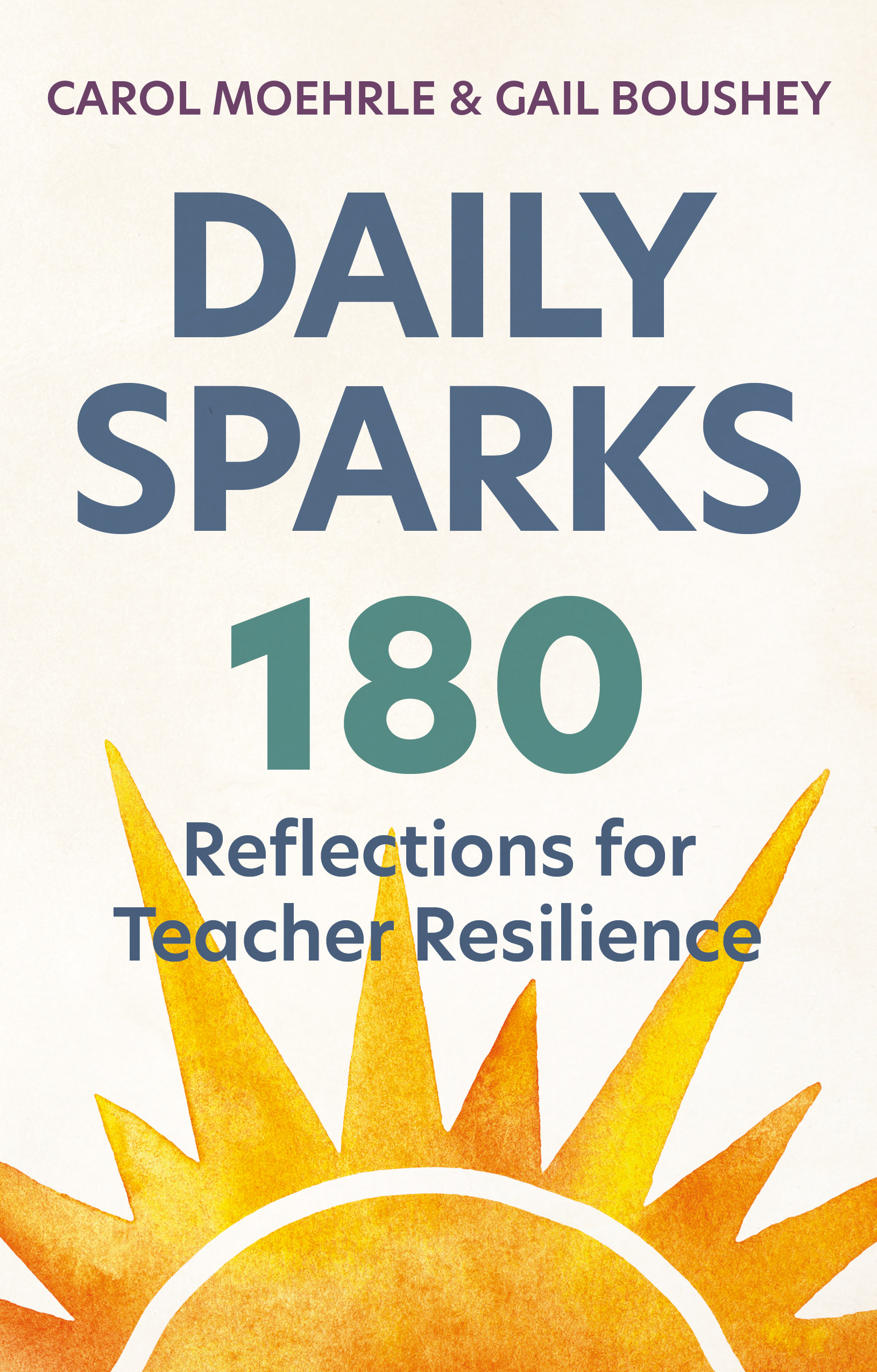
This is a giveaway of Daily Sparks: 180 Reflections for Teacher Resilience by Gail Boushey and Carol Moehrle, donated by Stenhouse Publishers (Routledge). Three copies will be given away to three separate winners. To enter the giveaway, readers must leave a comment on any Practices of Great Writing Teachers Blog Series post by Tuesday, Feb. 3 at 12:00 PM EST. The winners will be chosen randomly and announced on Thursday, Feb. 5. Each winner must provide their mailing address within 5 days; otherwise, a new winner will be selected. The publisher will ship worldwide so that anyone may enter.
References
Haskins, C. (2018). The Writing Problem: Teacher Self-Efficacy and Instruction. Learning to Teach Language Arts, Mathematics, Science, and Social Studies Through Research and Practice, 6(1). Retrieved from https://openjournals.utoledo.edu/index.php/learningtoteach/article/view/222
Premont, David, Shea Kerkhoff, and Janet Alsup. “Preservice Teacher Writer Identities: Tensions and Implications.” Teaching/Writing: The Journal of Writing Teacher Education, vol. 8, 2020.
Discover more from TWO WRITING TEACHERS
Subscribe to get the latest posts sent to your email.


”It doesn’t have to be good.” Amen! Just write!
LikeLiked by 1 person
Melanie, this is a rich post. I have gotten so much value from my life journey as a writer teaching writing. I never knew when I first attended the NWP writing institute in 1995 that it would completely mold and shape me into a writer as well as a teacher. I worry that the mantra of Donald Graves is being replaced by scripted teaching and way too many things to do for teachers. Data driven instruction has its place, but true writing is valuable professional development. I am worried about the future of teaching.
LikeLiked by 1 person