Estimated reading time: 3 minutes, 50 seconds. Contains 768 words
Target Audiences: Teachers, Instructional Coaches
Not too long ago, I was hanging out with some of my daughter’s twenty-something friends. They must know that I’m a stickler for grammar because one of them asked me to explain the difference between using “I” and “me”. Yes, I was that mom who pointed out passive voice in papers and taught proper comma usage.
As a grammar nerd, I’ve been looking forward to reading Not Your Granny’s Grammar by Patty McGee and Tim Donohue ever since I heard about it when it was barely in draft form. And yes, the final product is worth the wait. Don’t forget to leave a comment about how you hope to use this book to be entered in a chance to win! Thank you, Corwin Press, for sponsoring this giveaway.

Not Your Granny’s Grammar is one of those professional books that combines wisdom, theory, and knowledge with practicality, resources, and lessons. The first chapter provides a history of grammar and why it matters, with an explanation and rationale for the lessons that follow, and the second chapter delves into classroom set-up. After that, get ready for some meaningful lessons that guide teachers through not only meaningful concepts about words and sentence structures, but also impactful pedagogical practices— pedagogical practices like planning for exploration, collaboration, explicit instruction, practice opportunities, and ultimately… transfer.
The Organization
Organized in four main parts, the first part of Not Your Granny’s Grammar is about the history of grammar and an orientation to the rest of the book. It also includes a set-up for powerful teaching practices. Throughout the pages, Patty and Tim acknowledge the fullness of teachers’ plates, and they respect and empower teachers as the experts and captains of their classrooms. “…Teachers are problem solvers, creatives by nature, well-suited to this work of molding time” (p. 23), they write, offering suggestions, but not mandates or scripts. Instead, the book focuses on practices that lead to learning.
“…teachers are problem solvers, creatives by nature, well-suited to this work of molding time.” (p. 23)
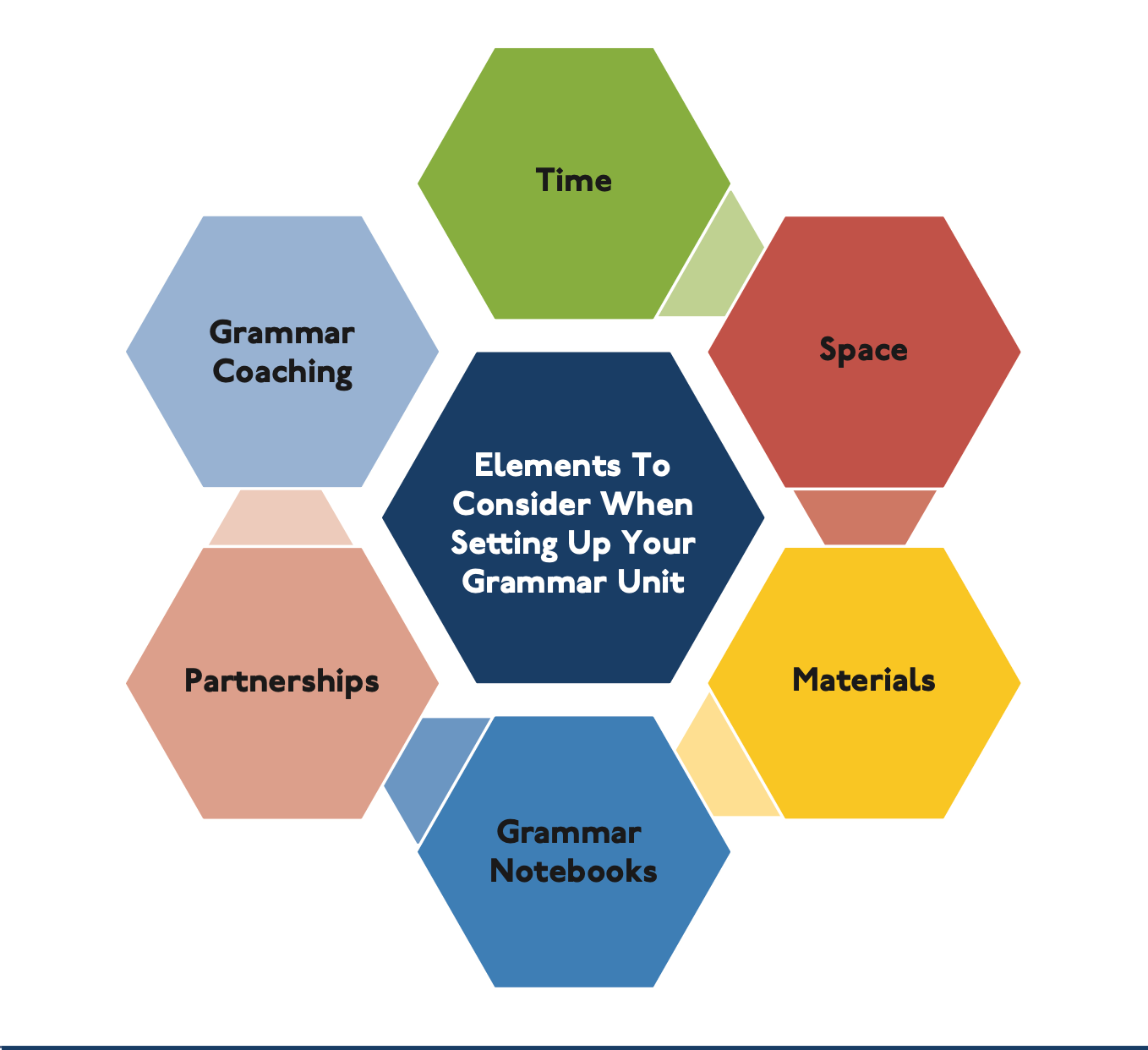
They describe setting classrooms up with spaces to collaborate, create, showcase learning, and practice quietly… practices that will amplify learning not only in grammar, but also in all subjects. No matter what content you’re teaching, the intentional movement through immersion, inquiry, focus lessons, and opportunities for transfer lead to impactful instruction.
Moving into the second part, you’ll find a sequence of lessons designed to be taught in order, involving students in a study of sentences with direct instruction of important concepts around sentences, clauses, and phrases. Lessons are clear, incorporating language, resources, and plenty of practice.
The third part of the book also includes lessons, but these lessons give teachers the opportunity to design their own units. Centered on mentor texts with opportunities for immersion, exploration, and transfer, these lessons are more like a “choose-your-own-adventure.” Patty and Tim encourage readers to “adapt the lessons to meet your students’ needs. If students have already mastered the skill of the identified lesson for the text, create your own lesson with a different focus” (107). For teachers who want it, there are specific references to texts. For teachers who are ready for it, there is guidance for selecting other texts that can also be used to center and inspire student learning. Regardless of your adventure choice, lessons include opportunities for assessing both of and for learning, emphasizing the importance of transfer and authentic use.
My favorite part of the book could be the fourth section which is a grammar refresher. As someone who loves grammar and constantly thinks about sentence structure, I dug into this section looking for what I might not know. The “grammar refresher is an invitation for you to join us on a tour of grammatical concepts and skills that are essential for student writers” (231). Need an explanation of clauses versus phrases? You’ve got it. A rationale for the use of semicolons and colons? It’s there. How about a dive into different types of pronouns, including subjective, objective, reflexive, relative, and possessive? You can find answers about those terms, as well as many other grammatical concepts that you might not even think to ask until you read this book.
Final Thoughts
In many conversations, I resist the urge to correct grammar; not too many people want to know they misuse “I” and “me”, and even fewer want to hear about the explanation for the mistake. In an upcoming podcast with Tim and Patty, Tim talks about the importance of grammar for students to read critically and write powerfully, while Patty emphasizes the possibilities of “finding delight in learning grammar.” Not Your Granny’s Grammar does it all, blending purpose and play throughout the lessons.
_____
Giveaway Information
Many thanks to Corwin Press for providing a copy of Not Your Granny’s Grammar for our book giveaway. Leave a comment below for a chance to win! Comments for this giveaway close on September 20, and Melanie will notify the winner. The winner must provide their mailing address within five days, or a new winner will be selected. While TWT readers from around the globe are welcome to leave a comment, you must have a U.S. mailing address to win the book.
Discover more from TWO WRITING TEACHERS
Subscribe to get the latest posts sent to your email.


I love teaching grammar with purpose and with models. Jeff Anderson and Constance Weaver have been my guides, and I can’t wait to see what new ideas await me in this new book!
LikeLike
This book is so timely. AI does not teach grammar the way Patty does.
LikeLike
As an instructional coach, I have been trying to help my teachers plan grammar instruction beyond just skill and drill worksheets. I can’t wait to dive into this wonderful resource to support them with this crucial work!
LikeLike
Patty has worked with the teachers in our district and I always come away with wonderful ideas and inspiration. I am an instructional coach and am looking forward to using this book with the teachers in my building!
LikeLike
Making grammar interesting to learn and transferable in students’ own writing is an ongoing challenge. I am confident that this book will promote new insights and ways of thinking around the subject and I look forward to using it.
LikeLike
Making grammar interesting and transferable in students’ writing is always a challenge. It will be an exciting and refreshing prospect using this book when assisting all involved in the process.
LikeLike
I have the opportunity to support writers in a third grade classroom, along with a student I tutor. Having readily available “go-to’s” for grammar and the knowledge that Patty brings to her work will be most beneficial to me. I look forward to reading NYGG and implementing strategies, along with the continuation of learning for myself and my students I encounter.
LikeLike
I’m working with some v.e.r.y apathetic kiddos who hate everything writing, grammar, or revision/editing. Mat NYGG is the twist to hook them back into their learning.
LikeLike
This book sounds like the perfect blend for teaching grammar! I can’t wait to read Not Your Granny’s Grammar for the ideas and lessons within. 🙂
LikeLike
I’m the grammar nerd in my family and love having the title! I’m excited that there is a book out there that I can use to back me up when I’m questioned about my expertise. It’s already on my book list. Grammar nerds unite!
LikeLike
Always looking for books that can combine the “why” and the “how” of teaching and learning. This one looks like it does both and can provide easily accessible turnkey ideas.
LikeLike
Went to a workshop with Patty McGee and “played” with some of the ideas in the book. Anxiously awaited its release! Can’t wait to read the book and try these ideas with teachers and students!
LikeLike