Estimated reading time: 4 minutes. Contains 831 words.
Target Audiences: Early Childhood Educators
How We Got Here
As we head into a new school year, my mind is already racing with questions about how I want to approach writing in my pre-K classroom. While it is my 13th year teaching, it will be only my second year with this grade level. I am excited about the possibilities for writing that will play out in my classroom. Still, I am also curious about how other early childhood educators approach emergent writing, i.e., drawing, dictation, storytelling, labeling, and bookmaking (among other modalities) in their classrooms.
I recently sat down with Cathy Grupper, a masterful and inspiring early childhood educator who teaches a 4/5’s class at Union Cong, a Reggio Emilia-inspired nursery school in Montclair, NJ. My daughter was lucky enough to be in her class this past year, and so I was eager to learn about how she structures and supports opportunities for emergent writing across the school day.
The Details
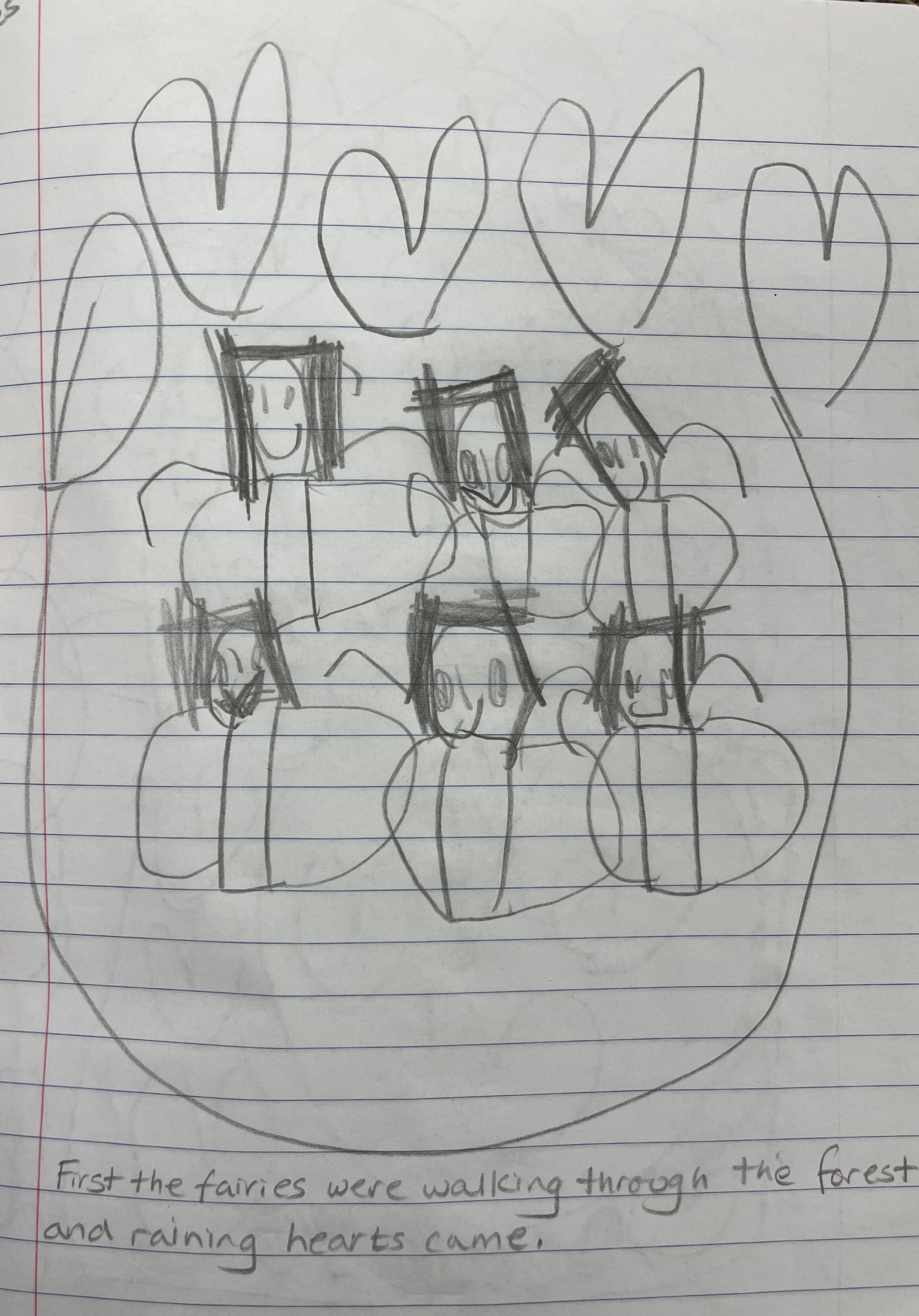
Journals: In Cathy’s class, writing happens organically. During the first week of school, she gives each child a black and white speckled composition book, which serves as their journal. She makes it a very exciting occasion by explaining that their journal is a special place where they can draw and write about anything they want. The children write in their journals every day after they clean up their snack, and twice a week, Cathy and her co-teacher(s) take dictation. Cathy truly lets the children take the lead and honors whatever language the child uses to describe their drawing — from a one-word label to a complex story. She engages each child in a conversation about their work, prompting them to say more when possible, and infusing rich vocabulary along the way, (i.e., “I notice you made a looping line today!”) As the year progresses, some children begin to write stories that can be acted out by the class in the manner of Vivian Gussin Paley’s “storyacting” methodology. Journals provide her four and five-year-old students with a predictable and consistent writing routine that is both personal and social.
Writing Basket: Each day includes a “work time” during which children choose where they want to play. One of the choices is always a “writing basket” that contains dry-erase boards, markers, an alphabet and number chart, and rings of relevant words. For example, at the beginning of the school year, there is a ring of words related to names and families: mom, dad, brother, sister, etc. At other points in the year, the word rings could include seasonal or holiday-related words, as well as words that pertain to the things her students are most interested in at any given time, such as rainbows, superheroes, or animals.

Book Making: Around Thanksgiving time, Cathy works with each child to create a page for a class “Thankful Book.” The pages feature a drawing of what each child is thankful for, along with the dictated description. Cathy makes sure to introduce the concept that they are authors and illustrators who can create books, just like the authors and illustrators who make the books she reads to them during storytime. From there, she typically finds that children begin to naturally make their own books during work time. She organizes the art center with paper and drawing materials, and teaches them how to use a stapler safely. After drawing on several sheets of paper, the children learn to staple the pages together and dictate their story to her. She also explains that their books need to have a title and “by” their name on the front cover, as well as the words “The End” somewhere in the back. Once a book is finished, the children have the opportunity to read their book aloud to the class (usually with Cathy’s help). This, of course, is where so much of the magic of being an emergent writer happens.

What’s Next
Writing in the pre-k classroom is definitely not the same as writing in a K-5 classroom. Still, with engaging opportunities for children to draw about and dictate whatever is essential to them, it so powerfully builds the foundation for what’s to come. As Cathy remarked, “Writing is communicating!” If you are gearing up to head into a pre-k classroom like I am, I hope you will find the ideas in this blog post useful. I know that I will try them all.
Cathy Grupper holds a B.A. in Art History from Cornell University and an M.S. in Museum Education from Bank Street College. She has worked in Central Park, the Brooklyn Children’s Museum, and the Brooklyn Botanic Garden. Cathy was an American delegate for the Reggio Emilia Study Tour in 2016. She joined the Union Cong faculty in 2008.
Discover more from TWO WRITING TEACHERS
Subscribe to get the latest posts sent to your email.


