Estimated Reading Time: 3 minutes (604 words)
Primary Audience: Teachers, Coaches
The Context: One night last week after our kids had gone to bed, I was working on minilessons for a 2nd grade informational writing unit while my husband was playing around with the newest version of Gemini, Google’s large language model. “Let’s see if Gemini can write lessons for you,” my husband suggested. Curious, I started playing around to see how Gemini could help me with minilesson planning.

What I Found: First, I wanted to see if Gemini could follow the same template I was using. I told Gemini reference “Mini Lesson Plan W1-D3: Writing more with transition words” in My Drive to write a lesson plan for the next day for 2nd graders using the same template. Here is the example I provided and the minilesson Gemini generated:

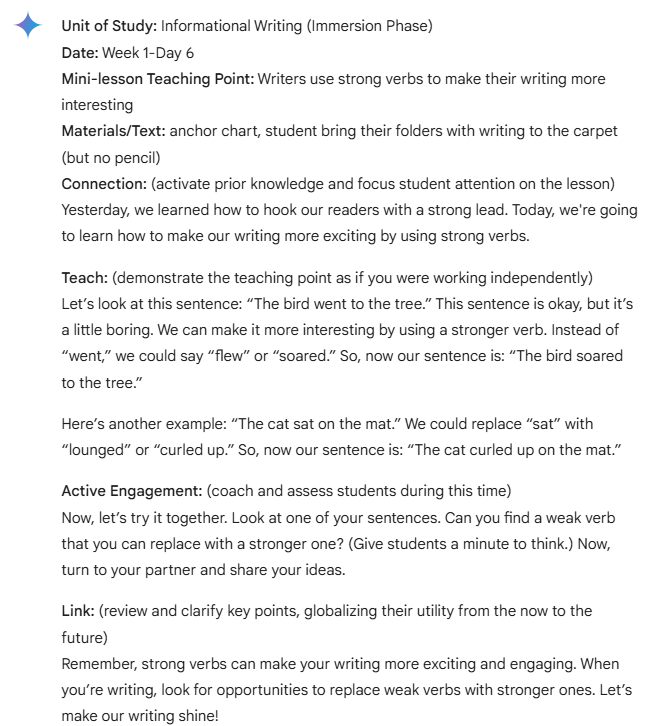
Not too bad, I thought. Not only did it follow the template, but it came up with a 2nd grade appropriate teaching point on its own. Now to see how Gemini’s lessons compare to my own. I asked Gemini now write a lesson plan with the teaching point “informational writers use expert words and definitions to teach their readers.” Continue with the example of gardening. Here’s what Gemini wrote and the lesson I had just written:


The two lessons are very similar. The main difference is that the one I wrote is specific to the writing that I have been modeling for my students, whereas Gemini’s lesson included more generic examples. My lesson plan also included more references throughout the minilesson to the teaching point and why it is important for writers to do.
Impressed, I continued exploring what Gemini could do. I asked it to write a minilesson for the teaching point “writers hook their reader with a strong lead.” It wrote a minilesson that taught students to ask a question to hook their reader. Then I asked it to revise that minilesson to use a different topic for an example, which it did. Then I asked it to include another way to write a hook other than ask a question. It revised the lesson to teach students to hook readers by asking a question or starting with an interesting fact (you can check out my entire conversation with Gemini and all the versions of the minilesson it generated here). I also asked it to generate a list of other possible teaching points, and it gave me ten ideas separated into different categories like Organization and Structure, Audience and Purpose, and Text Features.
The Bottom Line: While I still think my minilessons are better than Gemini’s (of course), I am finding that I can use Gemini’s lessons to be more efficient. Sometimes Gemini’s lesson provides me with the basic minilesson plan that I can then personalize to fit my instructional context. Sometimes Gemini gives me the example to use when I just can’t think of a good example on my own. One time, Gemini’s minilesson worded something in just the right way for me to see a connection that I had overlooked between the writing unit and the current reading unit. I also recognize that I have twenty years of experience writing minilessons and teaching units of study, so I am able to come up with teaching points and write minilessons pretty easily. For teachers who are newer to these tasks, Gemini can help save a lot of time and energy!
Have you used Gemini or other AI tools to help you write minilessons? I’d love to hear about your experiences in the comments below.
Discover more from TWO WRITING TEACHERS
Subscribe to get the latest posts sent to your email.


