Estimated reading time: 6 minutes, 58 seconds. Contains 1395 words
Primary Audience: Teachers and Coaches
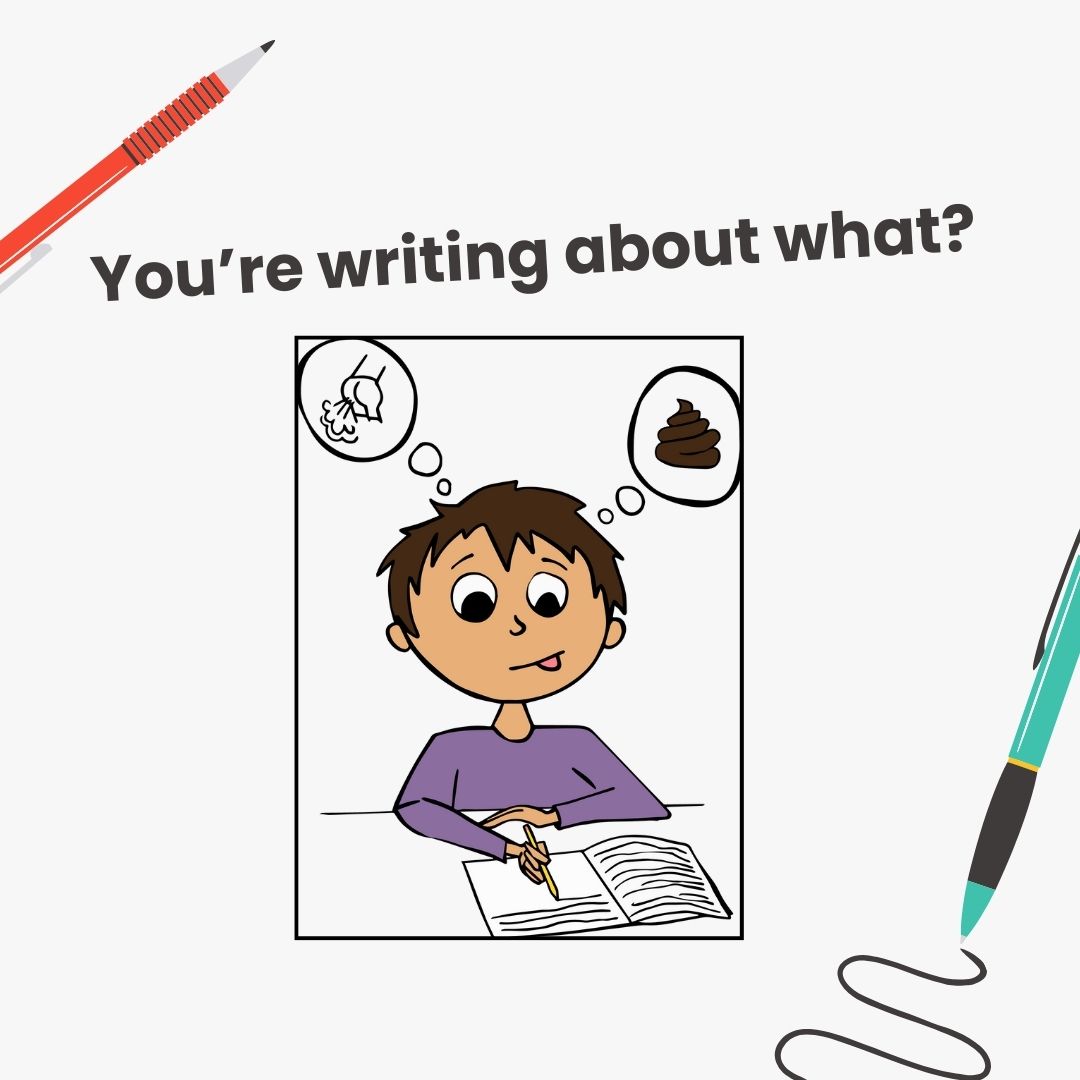
“We have to work on idea generation,” a teacher said to me in a conversation about a student writer. “All he wants to write about is poop and guns.”
“Actually, there are a lot of stories that exist around those two topics,” I suggested, trying to stay within the realm of her comfort zone, but nudge her thinking.
It could be that a great story exists poop and farts and video games.
Many young writers, stereotypically but consistently in my experience, more boys than girls, struggle with idea generation, and video games and guns tend to lead the idea generating challenge. Following those topics are poop, farts, and play-by-play athletic events. This pattern befuddles many teachers because they focus on the potential inappropriateness as opposed to the potential for a great story. One potential may not be mutually exclusive of the other, and It could be that a great story exists poop and farts and video games.
Possible Reasons for Topic Choice
Considering the reason for the topic choice is a powerful way to decide on a response. While I’m sure there are additional reasons, I’m sharing a few common ones in my own experience of working with young writers.
Not much else going on
Especially during the 2021 and 2022 school years, I struggled to find engaging ideas with some writers. While I’m pretty adept at finding topics in the mundane, children don’t see the possibilities for stories that come to life from toe stubs and spilled water glasses. For them, stories generate through vacations, outings, and playdates. The more students (and adults, too!) can realize the importance and value in daily moments, the easier it will be for them to think of ideas and topics for writing.
Some recent mundane, but brimming-with-possibilities– writing topics
Breaking my new French press coffee pot
Forgetting to pack my sunglasses when returning home
Remembering to pay a bill
Coaching my daughter to put a stamp on the correct side of the envelope
Breaking down the boxes for the recycling bin
All of these stories could lend themselves to a structured, elaborated page or so of writing. I wonder about spending more time modeling idea generation around the mundane may be worth the time at the beginning of the year, as it could allay some of the nothing-to-write-about syndrome that exists for many writers. Slice of Life participants know and understand the value of finding stories throughout daily life.
Looking for peer approval and fitting in
It’s human nature to want to fit in, and this tendency impacts idea generation. For many elementary boys, being cool involves Fortnight and Call of Duty, especially if they’re not athletes with great goals or winning shots in their repertoire. What if these writers could “pretend” to be someone? What if they could write stories they wished could exist in the world instead of true stories? These tweaks to the idea generation process could help writers who are looking to fit in.
Wanting to be funny
Poops and farts tend to show up for the wannabe comedians in writing classes. Funny writing is a popular genre for many readers and a profitable one for writers! A quick google search provided me with many possible mentor texts of for funny fart stories if you don’t have your own memory for a demonstration text. (I do.) Another search gave me many stories about struggles to flush. (I have to say… those stories provided me with not only a giggle, but also relief that others have shared my similar struggles.)
Task Avoidance
Students who don’t want to write learn quickly that as long as they don’t have a topic, they can’t write. They also learn quickly that if they come up with a topic that makes their teacher gasp, blush, or roll their eyes, they are also in the clear when it comes to writing.
On a related and important note, consider how powerful it is for writers to choose a topic that evokes an emotional response. If a writer can make someone gasp, blush, or express annoyance, they’re tapping into the mightiness of the writing pen.
Possible Solutions
An early question I’d pose to a wannabe gun-topic writer is “What story are you wanting to tell.” If the answer is “I don’t know” or silence– which it frequently is– , I’ll go with the assumption that the writer wants to write a story, and I’ll offer some ideas.
For the writer who wants to write about:
I might ask or suggest:
I can envision a text like:
Guns
What do you know about guns? What memory do you have about guns? Who is your audience?
An informational book about guns The time I got my first (toy!) gun Why gun safety is important
Video games
Who is a favorite character in your video games? What’s a struggle or some trouble that character faces? Could you pretend to be a character in your video game? Could you get stuck in your video game? (Where the Wild Things Are is a great mentor text for this question!)
Captain Marvel gets a new cape I design a game (or whatever else) with Roblox I win the battle as a sniper in Fortnight
*Stacey recently introduced me to the PRESS START series, terrific mentor texts for video-game-obsessed writers.
Blood and violence
Who is your audience? What is the character’s trouble and how is it solved? How can you keep the story manageable in a way that you can write it?
A graphic sports injury on the field impacts an athlete’s future in the league A retelling of a famous battle from history through a specific point of view A boxing match, with no physical detail spared
Anything scatological
What’s the trouble, and what’s the solution? How do you want your reader to react?
Blaming a fart on someone else in the room Farting in public and dealing with embarrassment Not being able to flush Accidents of any kind
Red Flags, Warning Signs, and Hard No’s
Sometimes written expression is a window into emotions and secrets. It’s important to pay close attention to the emotions that underlie the writing of children– or anyone, for that matter.
Given the prevalence of bullying, depression, weapons, and school shootings, there are many concerns that could emerge in writing. If I am ever working with a child and the writing concerns me because I think it shows evidence that the child could harm themself or others, I share my concerns with other adults including but not limited to the child’s teacher, principal, social worker, and school psychologist. I do this as soon as I have a concern about anyone’s safety.
Additionally, as a parent of daughters with digestive tract issues, I would welcome the normalization of conversations about poop and farts. Maybe allowing and even encouraging stories about these topics would help children feel more comfortable about sharing digestive and excretory issues. The stories may not always be funny; they could also be serious and important for physical well-being.
The early establishment of systems and structures in writing classes helps avoid many potential issues. An early expectation I establish for student writing is that classmates’ names do not appear in others’ work. This expectation eliminates written violence against other students in the room. Most young children do not know what hate speech is, but it’s not allowed. I have not experienced writing with hate speech, but if I did, I’d teach a child what it was, why it’s a problem, who is impacted, and other ideas for writing. Additionally, I establish the concept of audience early in the year. Many issues don’t come up if children know and understand that they are writing for an audience, and any of their work could be shared with classmates and families.
Final Thoughts
I’m not sure I convinced the young teacher to encourage poop and guns in writing (and encourage is a strong verb here; tolerate may be a better choice), but maybe she’s shifting her stance. Written expression already has many rules and potential pitfalls, so if there are some I can eliminate, I’ll do it. Additionally, there’s a market for gore. According to celebrityworth.com, Stephen King, a successful novelist with a propensity for horror, is worth over $500 million.
Remember: Keep kids safe, but keep them finding joy and inspiration while writing.
___________________
Giveaway Information:
This is a giveaway for a free, 30-minute virtual professional development session with Kate Roberts and Maggie Beattie Roberts. Readers must leave a comment on any or all of the TWT HELP DESK BLOG SERIES POST by Sun., 8/11 at noon EDT. We will announce the giveaway winner at the bottom of the intro post to this blog series (from 8/2/24) by 8/12/24.
Discover more from TWO WRITING TEACHERS
Subscribe to get the latest posts sent to your email.
I am the Writing and Social Studies Coordinator in Simsbury, CT, and I love what I do. I get to write and inspire others to write! Additionally, I am the mom to four fabulous daughters and the wife of a great husband.
View all posts by Melanie Meehan
2 thoughts on “TWT Help Desk: What If a Child’s Topic Makes Me Uncomfortable?”
What an important topic to address. This was a big issue when I taught 3rd grade at a co-ed school. Now that I’m teach in a girls school there are many guns or violence. Farts and poops are there and I allow them for their personal writing but not for published writing. So they get to write it but not publish it as a book unless they want to do that at home. The one topic that girls write about is friendship and excluding certain students. This is a hard no and we talk about it in class openly. Some kids also write about family problems and these are addressed privately with teacher and school psychologist. Thanks for bringing this topic to the forefront. I’d love to hear what other schools/teachers are doing.
Such a respectful and thoughtful approach! And the idea of audience creating a healthy self-consciousness (your parents will read this at our celebration) sounds helpful. When teaching first graders I felt, as you say, they had trouble valuing those small moments in their lives as worthy of writing. Teacher stories, especially about shared classroom small moments, help. And I really appreciate your plea for more normalization of digestive issues!


What an important topic to address. This was a big issue when I taught 3rd grade at a co-ed school. Now that I’m teach in a girls school there are many guns or violence. Farts and poops are there and I allow them for their personal writing but not for published writing. So they get to write it but not publish it as a book unless they want to do that at home. The one topic that girls write about is friendship and excluding certain students. This is a hard no and we talk about it in class openly. Some kids also write about family problems and these are addressed privately with teacher and school psychologist. Thanks for bringing this topic to the forefront. I’d love to hear what other schools/teachers are doing.
LikeLiked by 1 person
Such a respectful and thoughtful approach! And the idea of audience creating a healthy self-consciousness (your parents will read this at our celebration) sounds helpful. When teaching first graders I felt, as you say, they had trouble valuing those small moments in their lives as worthy of writing. Teacher stories, especially about shared classroom small moments, help. And I really appreciate your plea for more normalization of digestive issues!
LikeLiked by 1 person