I was the kind of child who wanted to hang out with my grandparents and learn their stories. All four of my grandparents were Jewish immigrants to Cuba in the 1920s. They started new lives on the island, which gave them refuge on the eve of the Holocaust. I was very curious about their journeys to Cuba and how they had adjusted to a new language and a new culture.
Thanks to their journeys, my parents were born in Cuba, as was I and my brother. But after the cataclysmic changes brought about by the Cuban revolution, which threatened my family’s religious faith and economic livelihood, we left Cuba, and began a new life in the United States. I too, as a child, became an immigrant, like my grandparents and parents, and like them, I had to find my way in a new place.
I think these experiences led me to want to write. We had lost so much, and someone had to bear witness to the loss, and hold on to it in something as intangible but yet so real as a story.
So I write to remember. To remember those who held me in their arms when I was little. To remember the places where we once lived and are now lost but not forgotten. To remember those who came long before me and I didn’t know, but seek to imagine, and bring to life again. To remember, also, those who I know and love today, in the present, and want to honor. I write historical fiction, trying to understand the history of the past and the history of the present. I draw upon memory and research. What I can’t recall or document, I fill in with my imagination.
The first middle-grade novel I wrote, Lucky Broken Girl, was based on my life. But it wasn’t mostly about me. I wove in memories of my family and the neighborhood in Queens, New York where we lived when we first arrived in the United States. As I wrote, I remembered my grandparents, my parents, my brother, and friends and neighbors and others who touched my life in the late 1960s when the story takes place. I asked family members to share their memories with me. I researched the popular song of the era, “These Boots Are Made for Walkin,” which I remembered vividly. I read up on the civil rights movement occurring then. And I re-encountered a diary I kept in those years, which had a lock and key, to remember my voice as a young person.
Next I wrote Letters from Cuba, a novel that honors the memory of my maternal grandmother, who was a Polish-Jewish immigrant to Cuba, arriving on her own to help her father bring the rest of the family to the island as conditions worsened in Europe. Set in 1938 in rural Cuba, I drew upon memories that my grandmother had shared with me, historical research, and photos of my grandmother and our extended family in Cuba. I have an altar next to my desk with photos of my family. Every day, as I wrote, I’d look into the eyes of my grandmother in a photo of her as a young woman in Cuba, and try to imagine what she experienced and felt.
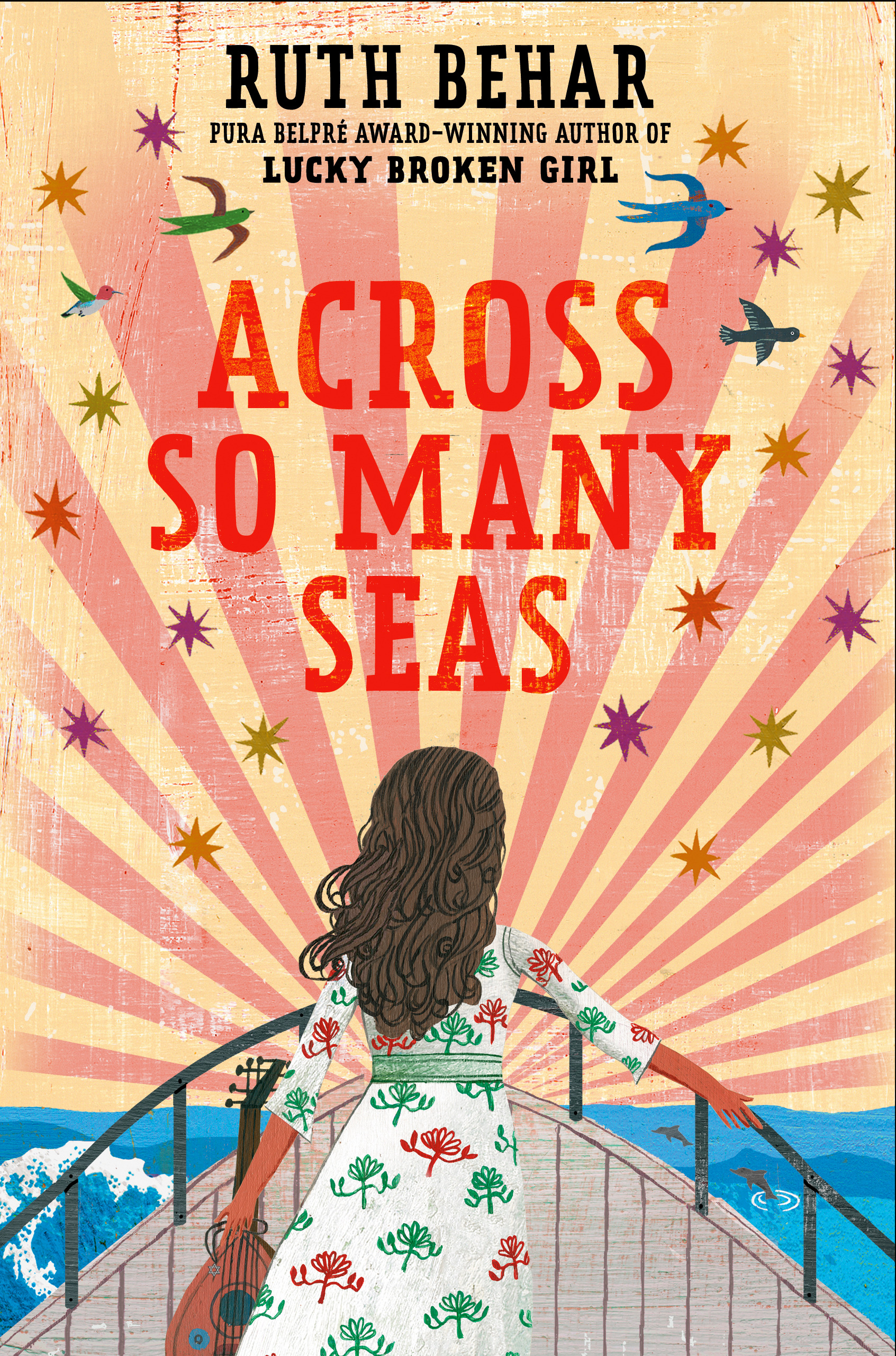
Now I’ve written a new novel, Across So Many Seas, which honors the memory of my paternal grandmother. She was a Turkish-Jewish immigrant to Cuba who was sent alone, mysteriously, to the island and never saw her parents again. She carried an oud and sang old Spanish love songs of the Sephardic tradition. I decided to give her story a wider historical arc. The novel begins in 1492 with the expulsion of the Jewish community from Spain, moves to Turkey in 1923, Cuba in 1961, and Miami in 2003. The world is seen through the eyes of four young girls living in each of those eras and their lives come together at the end in a museum in Spain where the story begins. I drew on historical research of the four historical periods and I listened to recordings of the old Spanish songs as I wrote. The poetry of the words and the sorrow about broken hearts inspired my writing. Music can be such an important inspiration for writing.
To inspire kids to engage with history, I suggest we encourage them to talk to elders—parents, grandparents, aunts, uncles, and neighbors— about their life stories. A conversation can begin by talking about family photos, whether they’re mixed up in a box or album, or scanned into a computer. Asking an elder what keepsakes they have and talking about the story they hold can inspire a young person’s writing. Enjoying an old song together can be wonderful too. And there are fascinating stories about holiday foods and family recipes that can open a door into the world of the ancestors. However a young person gets started in thinking about the world that came before theirs, the purpose is to learn to listen. To become a good storyteller, you begin by becoming a good storylistener. After learning to listen well, you can use your imagination to fill in the gaps and write the story that honors those who walked before you, leaving space for you to make your own path.
*

Ruth Behar is a cultural anthropologist and an award-winning author of books for young people. She won the Pura Belpré Award for her debut middle-grade novel, Lucky Broken Girl. Her next novel, Letters from Cuba, was selected for the Kirkus list of best historical fiction. Her picture book, Tía Fortuna’s New Home, is on Kirkus and School Library Journal best book lists. She and her son, Gabriel Frye-Behar, co-authored Pepita Meets Bebita, a picture book about the joys of family. Behar’s latest novel, Across So Many Seas, tells the stories of four girls from different generations of a Sephardic family. The first Latina to win a MacArthur “Genius” Grant, Behar teaches at the University of Michigan. Learn more about her at https://www.ruthbehar.com/ or on Instagram @ruthbeharauthor
Giveaway Information:
You can win a copy of Across So Many Seas by Ruth Behar, donated by Penguin Random House. To enter the giveaway, leave a comment about this post by Saturday, April 27 at 6:00 p.m. EDT. The winner will be randomly selected by Stacey Shubitz and announced at the bottom of the post by Thursday, May 2. You must have a U.S. mailing address and provide a valid e-mail address when you post your comment. If you win, Stacey will email you for your mailing address. We will choose a new winner if you do not respond with your mailing address within five days.
4/27 @ 8:50 p.m.: The giveaway is now closed.
Many thanks to everyone who left a comment. Sally Donnelly’s commenter number was drawn, so she’ll win a copy of Across So Many Seas.
Discover more from TWO WRITING TEACHERS
Subscribe to get the latest posts sent to your email.


”I write to remember”. I am not an everyday writer in a journal but when there is something good, bad, historical,
I write. I remember the words of author Mary Downing Hahn that “history is something we live each day”.
LikeLike
Thank you to Ruth Behar for such a meaningful post! This part really spoke to me: “So I write to remember. To remember those who held me in their arms when I was little. To remember the places where we once lived and are now lost but not forgotten. To remember those who came long before me and I didn’t know, but seek to imagine, and bring to life again. To remember, also, those who I know and love today, in the present, and want to honor.” This was a powerful reminder to me of how writing can help us hold onto those moments we want to always remember.
LikeLike
Such beautiful and poignant words from Ruth Behar. This part really spoke to me: “So I write to remember. To remember those who held me in their arms when I was little. To remember the places where we once lived and are now lost but not forgotten. To remember those who came long before me and I didn’t know, but seek to imagine, and bring to life again. To remember, also, those who I know and love today, in the present, and want to honor.” This was a powerful reminder of how writing is a valuable tool to help us hold onto the stories we want to cherish and never forget.
LikeLike
How wonderful for you to share the stories of your family with the rest of the world. I’m sure that many readers will see similarities between your stories and theirs. Writing to remember may be one of the most important reasons to write…for yourself and for those who come after you.
LikeLike
Thank you for sharing this post. It has inspired my writing and thinking. Continued success to you!
LikeLike
Thank you so much for this inspirational post! What incredible insight into yet another reason to write, as well as an amazing family and writing lineage. I am excited to add this latest book to my stack!
LikeLike
When I first read this post the words “So I write to remember” clicked with me. Rereading the post, the words that nudge me this morning are “to inspire kids to engage with history.” Letting that simmer as I plan.
LikeLike
This post came at the right time for me, Ruth. I hadn’t known about your books, but they are on my list now. My husband is Jewish and my mother-in-law would tell me of her grandparent’s journey from Russia to America. It’s amazing how much a person can endure and overcome and thrive. Thank you for writing about this topic. I eagerly awaiting reading all of them!
LikeLike
Your family story has so many generations experiencing immigration. So much learning, adjustment, loss and rebuilding. I love how you honor it all by telling the stories and imagining the ones you can’t know. I also am sure your life as an anthropologist merges your interests as well. I especially notice how you started writing mostly about yourself, then added in music, then expanded your view through more years of history and research. I’m so glad you are using your unique voice.
LikeLike
Thank you for this blog post. I love learning from authors, their why to write. Writing as a way to remember is a powerful idea! I’m heading to the library today to find your books!! #AuthorAreRockStars
LikeLike