
Estimated Reading Time: 4 minutes (Contains 826 words, excluding citations and the book giveaway text.)
Target Audience: K-6 Educators
WHY IT MATTERS: Time is one of the most important conditions for writing. Students can flourish as writers if ample time is allocated to write.

THE CONTEXT: The National Assessment of Educational Progress (NAEP) considers writing “one of the most important skills that students acquire and develop during K-12 schooling.”
The National Commission on Writing in America’s Schools and Colleges (2003) recommended that “the amount of time and money devoted to student writing must be dramatically increased in school districts throughout the U.S. and state and local curriculum guidelines must require writing in every curriculum at all grade levels.”
Writing instruction gets short shrift and rarely prioritized, like reading and math. As Lucy Calkins and Mary Ehrenworth noted, “In too many schools, this time is compromised” (2016). Writing is “not always the highest priority of district administrators” (Simmerman et. al., 2012).
AS A CONSULTANT: Whenever I receive a consulting inquiry, one of my first questions is, “How many times a week do your teachers teach writing, and for how long?” I know the research shows that teachers who dedicate one hour a day to writing instruction, and who use evidence-based practices (e.g., dedicate time to grammar, handwriting, and spelling; engage in formative assessment; instruction in various types of writing; teach strategies to work through all steps of the writing process) will witness tremendous writing growth in their students (Calkins, 2013; Cutler & Graham, 2008; Dockrell, Marshall, & Wyse, 2016; Graham & Harris, 2014). I know my work as a consultant will be impactful if these essentials are in place. However, evidence-based practices can’t be implemented well if regular writing time isn’t part of the daily schedule.
Here are three possible breakdowns for the writing workshop:
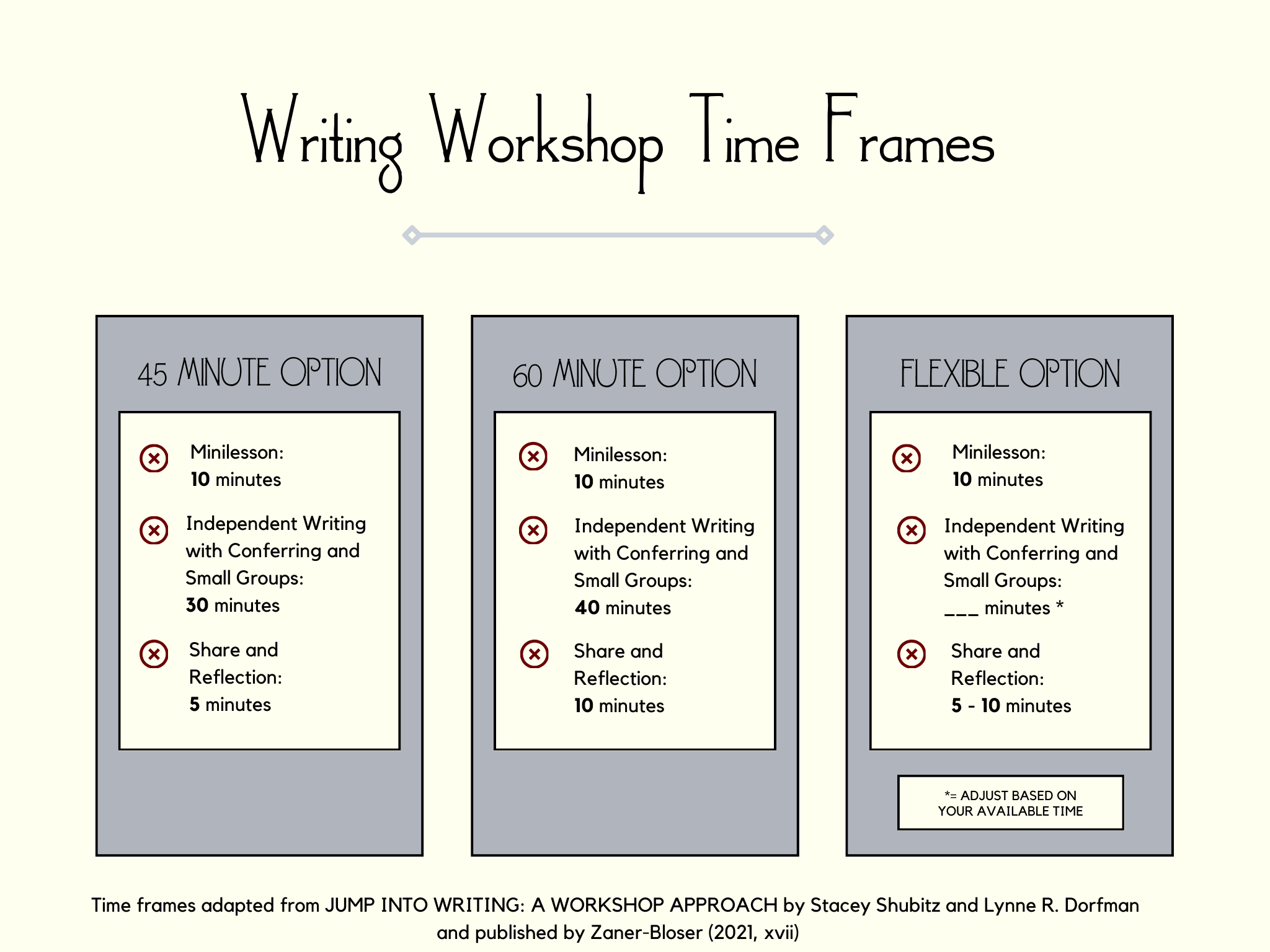
Writing instruction should happen five days a week. It’s possible to teach writing if it’s done for 60 minutes of writing time four days a week. However, if writing time is only 30 minutes each day or is only squeezed in two or three days a week, it’s doubtful teachers will be able to implement writing workshop meaningfully since the time they’re given for writing is neither ample nor consistent.
YES, BUT: In A Fresh Look at Writing, Donald Graves, an expert in writing education, asserted:
“Teaching requires us to show students how to write and how to develop the skills necessary to improve as a writer. And showing students how to write takes time. They need daily writing time to be able to move their pieces along until they accomplish what they set out to do.”
(Graves, 1994, 105)
Like any other skill, writing must be practiced for kids to become stronger writers.
OF NOTE: Dr. Steve Graham clarified that relevant stakeholders (e.g., teachers, administrators, policymakers, and parents) must be informed about the importance of writing instruction and its impact. Here’s what he said about informing society at large in “Changing How Writing Is Taught,” which you’ll see referenced throughout this blog series:
I have repeatedly noted that the public needs to value writing if efforts to change writing practices are to be successful. This includes knowing that writing is important, it needs to be taught, schools must devote time to teaching it, and many students do not acquire the needed writing skills. For parents of school-age children, it is also beneficial if they know the value of sharing their writing with their children, demonstrating a positive attitude toward writing, acting as a positive and constructive sounding board for their children’s writing, and serving as both partner and instructor (when appropriate) in the child’s journey as a writer (2019).
IMPLICATIONS FOR PRACTICE:
- Multiple people have said that a school schedule is a moral or ethical document. Stakeholders have to make decisions about where time will be spent. If writing is valued, classroom schedules will include a research-based amount of daily time allocated to writing workshop.
- Engaging students in writing about content has enhanced their learning in math, science, and social studies (Graham, Kiuhara, & MacKay, 2020). Looking for ways to infuse writing into the content areas is another way to prioritize writing instruction.
WHAT’S NEXT: It’s been my experience that many administrators are willing to work with teachers to ‘find time’ when they wish to allocate ample and consistent writing time daily. Read through the works cited (below) to prepare for a conversation with your administrator if you’re working in a school where writing instruction isn’t prioritized.
THE BOTTOM LINE: Writing is a crucial skill students need to develop. It is often neglected and not given enough importance in schools. Writing must be prioritized by devoting ample time to it daily.
GO DEEPER:
TWT Podcast
Works Cited
- Calkins, L. & Ehrenworth, M. (2016). Growing Extraordinary Writers: Leadership Decisions to Raise the Level of Writing Across a School and a District. The Reading Teacher, 70(1), 7-18.
- Cutler L, Graham S. Primary grade writing instruction: A national survey. Journal of Educational Psychology. 2008;100(4):907–919. doi: 10.1037/a0012656.
- Dockrell, J. E., Marshall, C. R., & Wyse, D. (2016). Teachers’ reported practices for teaching writing in England. Reading and writing, 29, 409–434.
- Graham, S. (2019). Changing How Writing Is Taught. Review of Research in Education, 43(1), 277-303.
- Graham, S., Harris, K. R. (2014). Six Recommendations for Teaching Writing to Meet the Common Core. In Write Now! Empowering Writers in Today’s K-6 Classroom, ed. Kathy Ganske. Newark, DE: International Reading Association.
- Graham, S., Kiuhara, S. A., & MacKay, M. (2020). The Effects of Writing on Learning in Science, Social Studies, and Mathematics: A Meta-Analysis. Review of Educational Research, 90(2), 179-226.
- Graves, D. A FRESH LOOK AT WRITING (1994). Portsmouth, NH: Heinemann.
- National Commission on Writing. (2003). The neglected “R”: The need for a writing revolution. Washington DC: College Board.
- Simmerman S., Harward S., Pierce L., Peterson N., Morrison T. G., Korth B., . . . Shumway J. (2012). Elementary teachers’ perceptions of process writing. Literacy Research & Instruction, 51, 292–307.
A Report of Interest
- Graham, S., & Hebert, M. (2010). Writing to read: Evidence for how writing can improve reading: A report from Carnegie Corporation of New York.

GIVEAWAY INFORMATION: This is a giveaway of How to Become a Better Writing Teacher by Carl Anderson and Matt Glover, donated by Heinemann. To enter the giveaway, readers must leave a comment on any BUILD YOUR EXPERTISE BLOG SERIES POST by Sun., 2/18 at 12:00 PM EST. The winner will be chosen randomly and announced on February 19. The winner must provide their mailing address within five days, or a new winner will be chosen. TWT readers from around the globe are welcome to enter this contest!
Discover more from TWO WRITING TEACHERS
Subscribe to get the latest posts sent to your email.


I so agree in as much as reading and writing do so much develop together, especially in kindergarten. Our writing time kept getting squeezed as the grade level schedule got adjusted 5-10 minutes here and there as the year went on. Fortunately my admin allowed me to switch it around to a different and actually more productive time of day which is working better now and allowing the full time needed. Thanks for this affirming article.
LikeLike
I agree that more time needs to be spent on writing. I don’t understand how, though. We also need to spend more time on science, social studies, math, etc. Where do we get the time?
LikeLike
I tend to discuss this with administrators when there’s a time issue. Sometimes it’s as simple as moving subjects around. Somtimes it’s more complicated. I don’t think there’s one answer to this qustion… it’s a case-by-case issue, which requires personalized solutions.
Feel free to email me if you wish to discuss further.
LikeLike
I love some of the questions you ask when you come to a school. Now, I want to figure out what writing instruction should look like in high school, especially in a system like ours that is semestered. I’ve spent several years encouraging my colleagues in other content areas to intentionally build reading tasks into their courses; writing needs to be there, too. The question for me is how to help teachers implement this – research will help.
LikeLike
Thank you for the reminder of writing instruction’s importance in elementary school education. It sets the tone for student performance and perception.
LikeLike