Estimated Reading Time: 4 Minutes (882 Words)
Primary Audience: Classroom Teachers and Instructional Coaches
A Back Story
In 2021, our school was beginning to recognize the impacts of the disruptions that Covid caused in our schools. I remember piloting a handwriting assessment in grade one. We asked students to write the alphabet in both uppercase and lowercase letters. The classroom teacher and I watched students write, noting formation and fluency. We noticed many students looking up at the alphabet chart for support. Many students did not have letter formation fluency. They did not have the imprint of the grapheme and, therefore, could not access it to write automatically. This is important because research suggests that “If a child has difficulties with producing handwriting that is fast and legible, it therefore may affect their academic performance” (Barnet & Prunty, 2019, p. 1). We knew we had to address what we were seeing.
Since 2021, our district has developed a more explicit handwriting curriculum because we have learned the importance of handwriting and the brain. “Handwriting serves to link visual processing with motor experience, facilitating subsequent letter recognition skills” (James, 2017, p. 1). Explicitly teaching letter formation and providing students time to practice, along with coaching, has proven helpful. However, even with this new curriculum in place, some students still struggle with getting their ideas out on paper, primarily due to their ability to write fluently.
Earlier this school year, I made it my mission to support one particular student who has always struggled with getting his ideas down on paper. Working with his classroom teacher, we devised a plan to try Voice Typing through Google as a tool during writing workshop. We agreed that there would be times when this student would be asked to handwrite assignments, but we wanted to see if Voice Typing could help him begin to see himself as a writer.
What We Tried
Having zero experience with voice typing, I jumped right in with this student. We pulled out his Chromebook and attempted to draft a personal narrative. I quickly learned that there was more to Voice Typing than just talking at your computer, just like there is more to writing than just getting the words down on the page. We needed to have a plan and account for the executive functioning work that students would need to use their voice to write on a device.
After a few unproductive sessions, I returned to the drawing board. I developed this tool to support students in the steps they would need to take to use their voice to type.
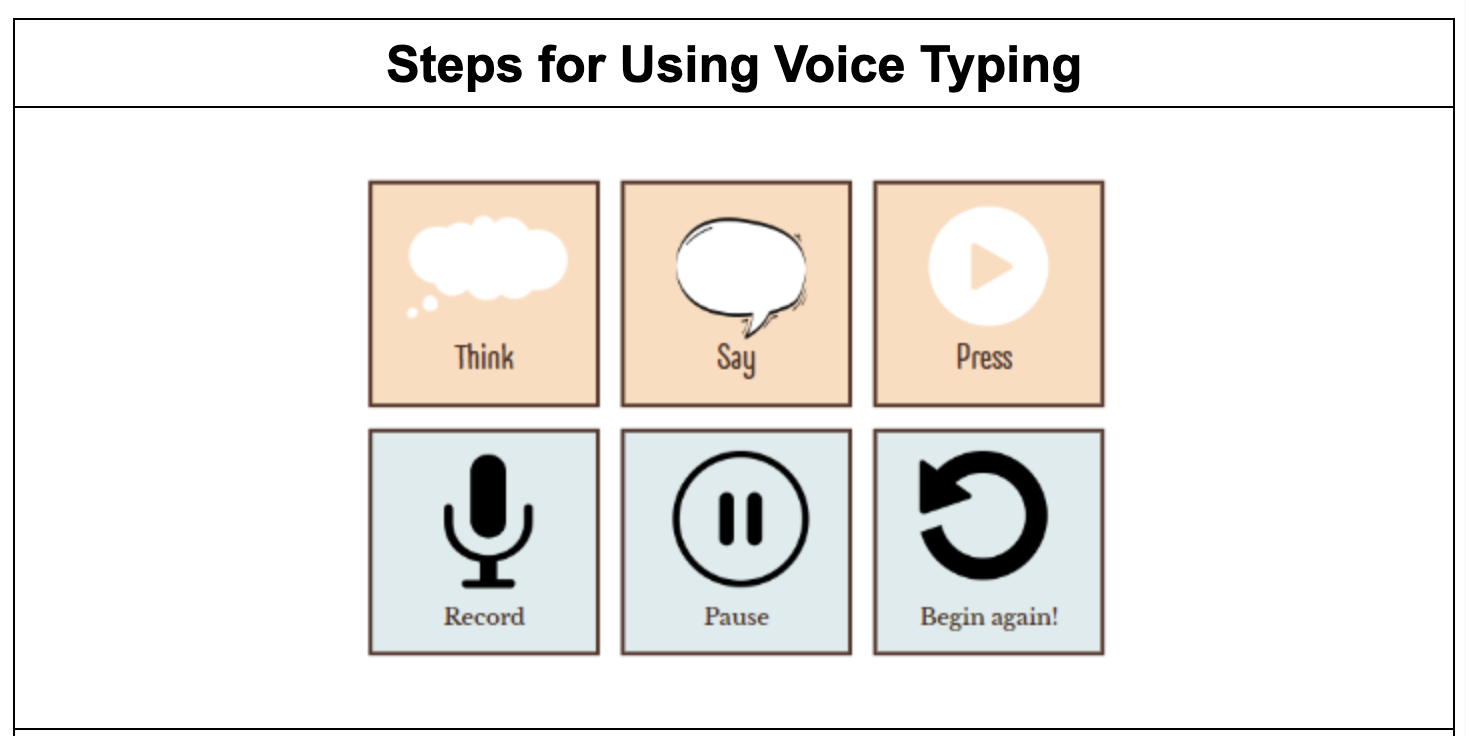
Click here to access a printable version.
Next, I decided the students needed to practice using the Voice Typing tool outside the writing workshop. They needed to learn the nuances of using their voices to type, including accounting for errors and punctuation. I printed short articles for the students to read. We highlighted the punctuation marks and practiced reading fluently. Then, we went back to the devices, experimenting with using the Voice to Typing Technology, accompanied by the step-by-step tool I had created.
Soon, students were much more comfortable using their voices to type texts. A bonus was that they were also getting fluency practice and getting experience hearing sentences properly punctuated. It took a bit of side-by-side coaching and me whispering “period” or “question mark” as students talked into their computers.
Next, students were ready to begin drafting their thoughts and ideas using Voice Typing. We learned that we needed to follow the writing process, generate ideas, and plan. Much of my collaborative work with students was around oral rehearsal, practicing saying the actual words they wanted to convey through their writing.
The Impact
Last week, I walked into a classroom just as the mini-lesson was wrapping up. I watched students grab their writing notebooks and find places around the room. I saw the student I have been working with to learn to use Voice Typing grab his notebook and Chromebook. He found a place at a table and got to work, writing.
With a little trial and error and some coaching, Voice Typing is proving successful for students who have struggled to see themselves as writers because of the challenges they experience with the act of handwriting. Melanie Meehan recently wrote a post called Entry Points and Pathways for Writers. In that piece, Melanie wrote about ways she has been exploring to create entry points for writers. Voice Typing has given some kids an entry point to access their ideas and be a part of the writing community. These students are now eager to get started during writing workshop and show great pride in seeing their words fill the page.
At our school, we continue to work alongside our OT to better understand and support the link between physical writing and its impact on students across their school day. However, right now, we have discovered a tool to help some students produce writing and to know that they are writers.
References
Barnet & Prunty, (2019 December 13). Accuracy and consistency of
letter formation in children with developmental coordination
disorder. National Library of Medicine.
https://www.ncbi.nlm.nih.gov/pmc/articles/PMC7008555/
James, K. H. (2017). The Importance of Handwriting Experience on
the Development of the Literate Brain. Current Directions in
Psychological Science, 26(6), 502–508.
Discover more from TWO WRITING TEACHERS
Subscribe to get the latest posts sent to your email.


Love this break down! Does the flow of the chart almost make a mountain? Think, then hit record, then say, then pause… etc.
LikeLike
We tried it moving left to right across the top and then left to right across the bottom. We found the oral rehearsal and planning to be so important!
LikeLike