Estimated Reading Time: 3 minutes, 12 seconds. Contains 640 words
Target Audience: Classroom Teachers and Instructional Coaches
The Context
My work frequently involves students who don’t like writing and have figured out ways to avoid it. Sometimes my question about these students is What can they do? Lately, I’ve also been asking Where do they get stuck?
What it Looks Like
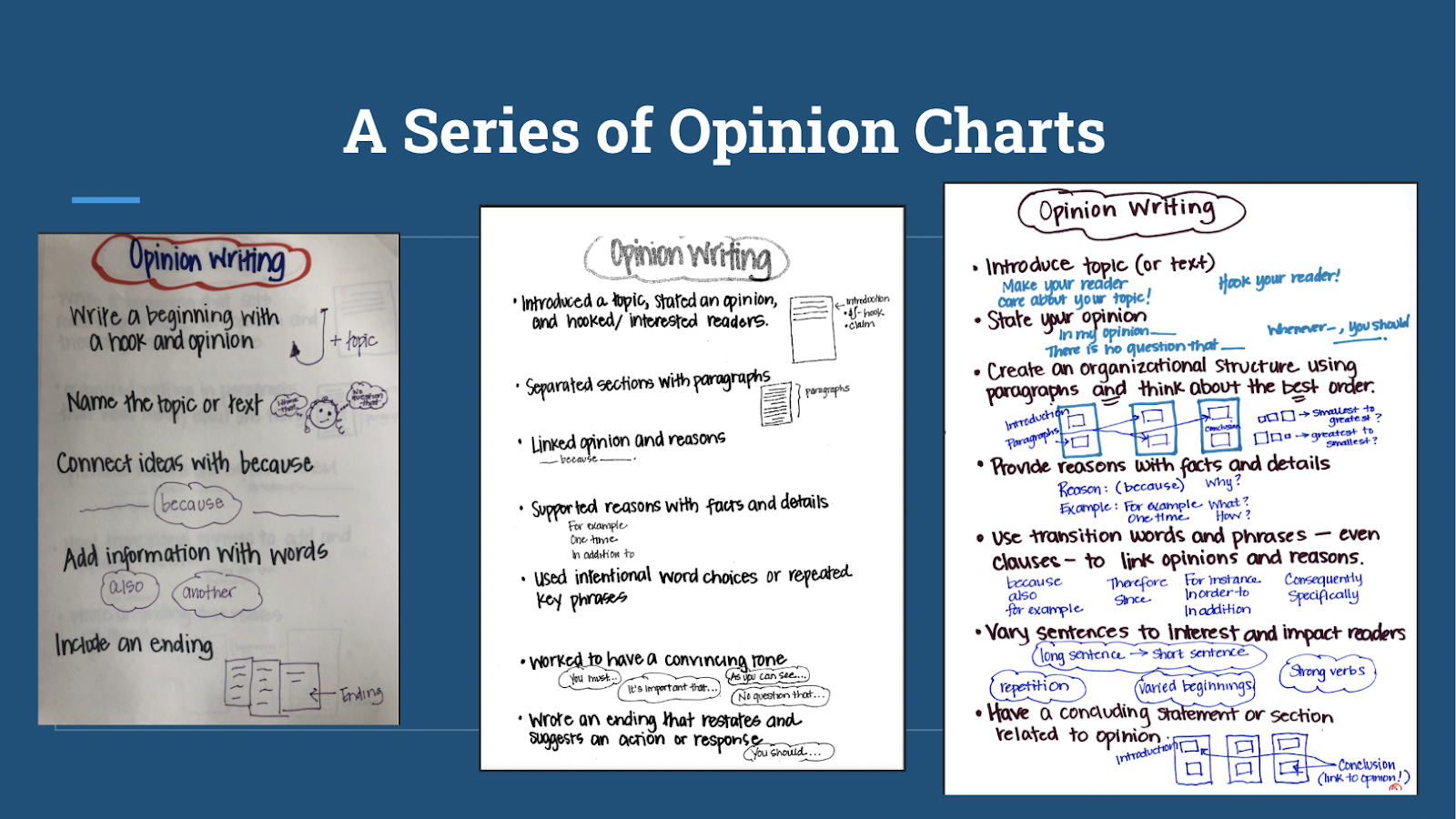
What can they do?: Once we consider the answer to that question, we have some possibilities for next steps. Over the years, I have created several series of genre-based charts which simplify the expectations. Maybe students aren’t ready for the chart on the right, but can they work toward the one on the left? And, if so, can we provide them with some meaningful practice opportunities so that they might be able to understand and work toward the middle chart? If that happens, then, in all likelihood, we’ve got some authentic growth and independent work happening.
Writing progressions work really well for providing students with pathways when the gap between what they can do and what they’re being asked to do is too large for independent work. No one is going to be successful with lifting a hundred pounds if their heaviest lift to date is a 25-pound weight. However, they might give a 30-pound barbell a try. We have many posts in the archives about progressions, and I recommend reading a couple of them. A couple favorites include:
- Student-Created Learning Progressions: A How to
- The Power of Progression: Expanding the Reach with Small Group Work
Where do they get stuck?: Recently, I’ve been spending more time exploring the possible answers and solutions to this question. If I think about writing with the chart below, it helps visualize some of the complexity.
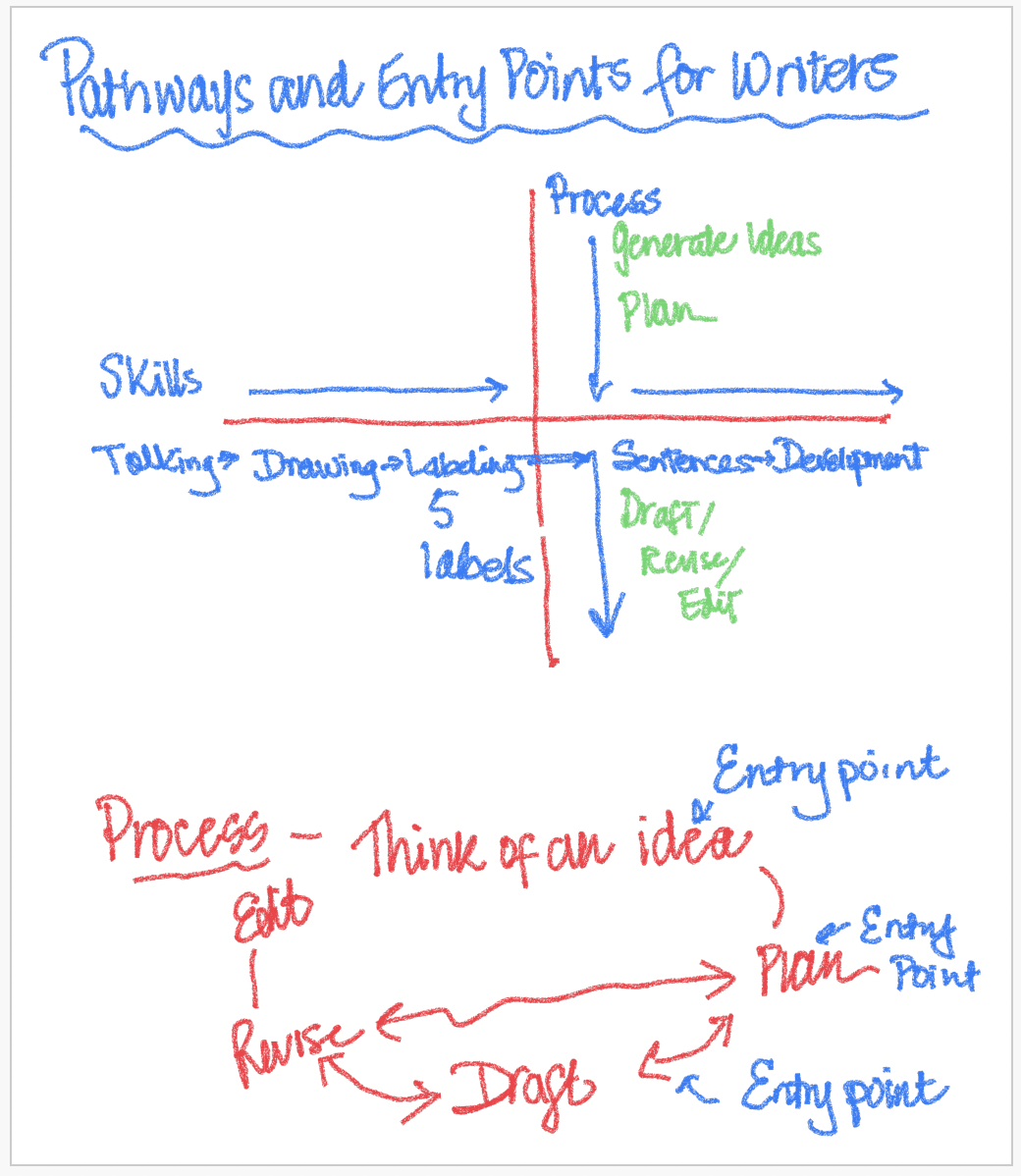
The horizontal access reflects skill development and is helpful when thinking about progressions and the series of genre-based charts. However, the vertical axis takes into consideration the process of writing. This process is far from linear, and I’ve tried to capture that truth with the bottom part of the page. That being said, if a student can’t think of an idea, then the opportunity to work along the horizontal axis doesn’t exist. Therefore, in addition to progressions, I have been working more and more on process-based entry points.
By leaning into and listening to students, I create pieces of writing that are partially done along the continuum of process. If I provide an idea and a plan, can a student continue the piece and draft? If they can, then they are getting some important practice. How simple do I need to make the idea and the plan? Here’s what I’ve seen happen: many students develop drafting skills by writing from my idea and my plan, and then they ask to write about and plan their own ideas. That’s exactly what I want to have happen.
To make it easier for myself, I have started to develop collections of genre-based sets at various steps in the process and at various levels. As an example, I have created All About Baking as a slide presentation. I’ve organized it with an introduction and a conclusion, and I included some pictures to suggest sections, but I intentionally did not name the sections, although I could.

By putting the work on slides, my expectation is that a student is working on a computer, and that might not be the case. I can also set up pieces on pages with lines, I can vary the lines, and I can present the idea and the plan to students and have them begin the drafting. Here are a few additional sets I’ve created.
Closing Thoughts
All of these are scaffolds, and, by definition, a scaffold should be temporary with a plan for removal. Sometimes, they have the power to invite students into the world of writing and the potential to provide practice. Maybe that’s what a student needs in order to find a pathway or entry point.
Discover more from TWO WRITING TEACHERS
Subscribe to get the latest posts sent to your email.


I’m taking a class in curriculum and there is a lot of work around brain research. You’re tapping in to so much of what I’ve been reading about! Love!
LikeLiked by 1 person
This is great – and so perfectly timed for the work I’m doing with a first grade teacher right now. Love the scaffolded examples of the writing pieces — and the entry points especially. Thanks for sharing your thinking and work on this.
LikeLiked by 1 person