Estimated Reading Time: 2:30 minutes (543 words)
Primary Audience: K-12 teachers, literacy coaches
Ever wonder why some of your multilingual learners (MLLs) leave the -s off of plural nouns? Mix up she and he? Omit subject pronouns? Or tell a story in a circular manner instead of following a linear plotline? The likely answer: linguistic transfer!
What’s happening: Language transfer occurs naturally for multilingual learners, regardless of if they are learning languages simultaneously (for example, growing up in a bilingual household) or sequentially (for example, growing up in a non-English speaking household and then starting at an English-speaking school). Transfer is the process of applying linguistic features from one language to another. Sometimes the features are the same in both languages, resulting in positive transfer. Sometimes the feature being applied is different in the other language, resulting in negative transfer.
Why It Matters: Understanding transfer is important for writing teachers with MLLs in their classes. When we are familiar with linguistic features with positive transfer, we can point them out to our MLLs and speed up the use of those skills in the new language. When we recognize negative transfer in our students’ writing, we can address it directly with our students in an affirming way. “I know this is how it works in (fill in language). Let me show you how it works in English.” This develops students’ metalinguistic awareness, the conscious understanding of how different languages work, so that they become more proficient and accurate speakers and writers.
Example in Action: Working in a Spanish-English dual language school means I regularly support students who are new to one of the languages. A bilingual alphabet is very useful for students who have letter-sound knowledge in their first language. Using charts like these ones created by my colleagues Gami Diaz and Ambar Dominguez, I can show students the sounds that transfer between the two languages and the letters that have different sounds. These alphabet charts were adapted from the Benchmark Education curricular materials the teachers were provided, but they rearranged the images to support linguistic transfer. Letter sounds that are the same in both languages (positive transfer) have a purple border. Sounds that are unique to Spanish have a green border, and sounds unique to English have a blue border (letter sounds with negative transfer).
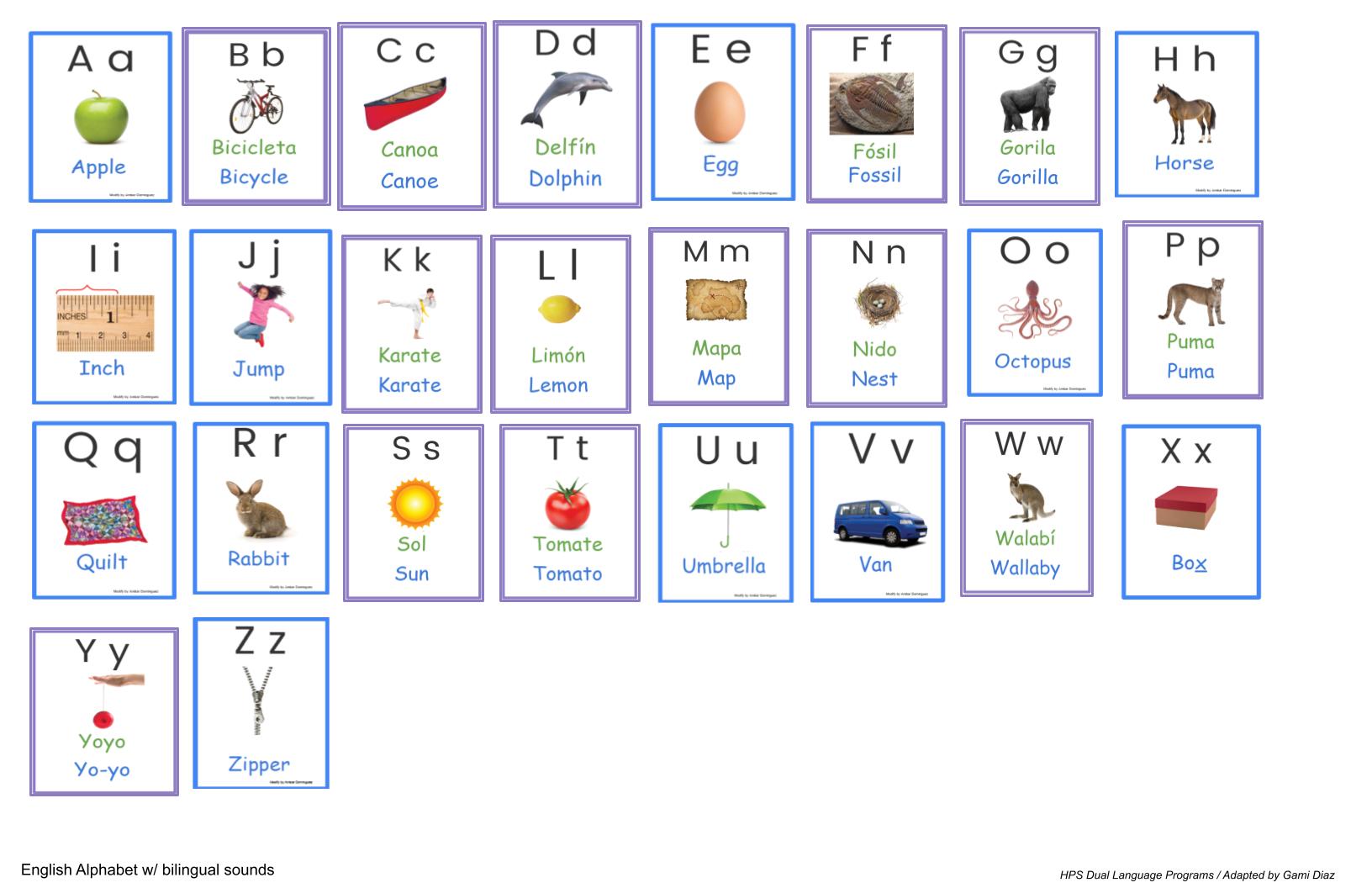


“Did you know that you already know a lot about how to write in English? All of these letters with the purple are the same in English as they are in Spanish-you don’t have to learn them again! All you have to learn are these English letter sounds that are different, the ones with the blue. They make a different sound in English than they do in Spanish.”
The bilingual alphabet can help students feel a little less overwhelmed about writing in a new language because they already know roughly half the letter sounds. The visual, color-coded alphabet is a tool MLLs can utilize as they begin writing in the new language.
Go Deeper: For more information about positive and negative language transfer between English and other languages, check out some of these websites. Keep this knowledge in mind the next time you confer with an MLL writer or read an MLL’s writing – you might find that you understand your student as a writer just a little bit better!
- Language Transfers: The interaction Between English and Students’ Primary languages
- Languages A-Z
- Phonemic Inventories & Cultural linguistic Information Across Languages
- Linguistic and Cultural Differences: Helping You Understand Your English Language Learners (start on page 55)
- Alphabet charts in other languages – Google “image: alphabet chart (name of language)”
Discover more from TWO WRITING TEACHERS
Subscribe to get the latest posts sent to your email.


