
High above there is the Moon, cold and quiet, no air, no life, but glowing in the sky.
Here below there are three men who close themselves in special clothes, who – click – lock hands in heavy gloves,
who – click – lock heads in large, round helmets.
These are the opening lines of Brian Floca’s gorgeous nonfiction picture book, Moonshot: The Flight of Apollo 11 (Atheneum Books for Young Readers, 2009). This certainly does not sound like the dry, fact-based information books I remember reading as a child. As a matter of fact, this sounds like something I’d like to read to my own children, cuddled up before bedtime with a blanket around us. This is a breathtaking example of a particular breed of nonfiction called narrative nonfiction. It educates like nonfiction, yet reads like a story. Perhaps a study of narrative nonfiction might help to infuse new life and creativity into your next information unit.
Understanding the Genre
In order to write narrative nonfiction, your students must first understand this genre. Of course, the best way to develop this understanding is to immerse yourselves in the genre. There are countless mentor texts of this genre. Some of my favorites are:
- 14 Cows for America by Carmen Agra Deedy
- Frog Song by Brenda Z. Guidberson
- Locomotive by Brian Floca
- Bat Loves the Night by Nicola Davies
After you and your students have read lots and lots of narrative nonfiction, you will want to work together to create a definition of the genre. Remember that narrative nonfiction includes certain elements of narrative writing such as characters, dialogue and sequence of events. However, the content is informational. It is factual information, written in story form.
Conducting Research
When the fifth graders in my previous district wrote narrative nonfiction, they conducted research and collected information the same way they would in any other information unit. They read books and articles on the internet. They used their own background knowledge. They talked to experts in the field. What differentiated this unit from other information writing units is the next step.
Finding a Story
Before beginning their drafts, we had students envision their final piece and come up with a narrative story to tell. Their story would be the container for all of their research. We looked back at the mentor texts and discussed each of the author’s stories. For example, in order to teach us about the Transcontinental Railroad in Locomotive, Brian Floca told the story of a single locomotive as it traveled across the country. In Moonshot, we followed the story of three astronauts as they journeyed to the moon and back. In order to teach about the behavior of bats, Nicola Davies told us the story of a single bat’s journey through the night in Bat Loves the Night.
In the same way, we guided students to use their writers’ notebooks to brainstorm and envision their stories. Here is how I might think aloud through this process:
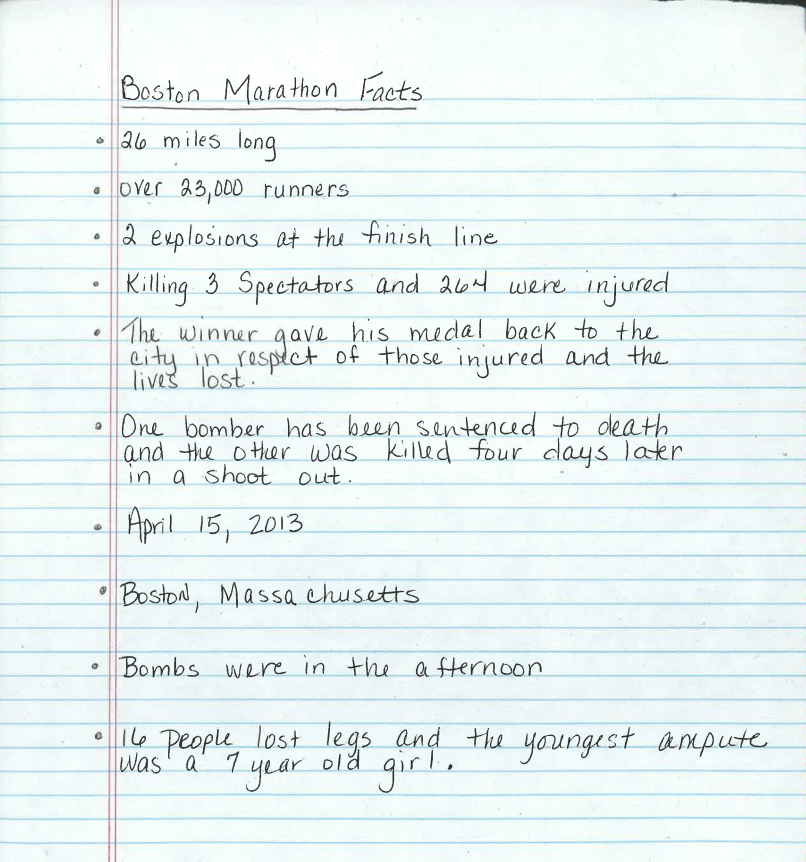
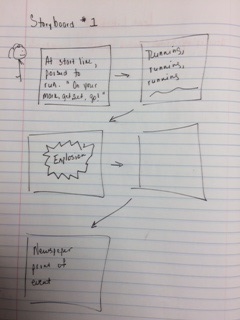
I am writing an information piece on the Boston Marathon bombing in 2013. I have all my facts gathered, and now I am trying to envision what story I might tell as I teach my readers about this tragic and sad event. I am thinking I might tell the story of a single runner. I could follow the runner from the starting point and through the race. We could experience the race with her – feet hitting the pavement, sweat dripping, breath heavy. She could hear the explosion and see people scattering in all directions. She watches, unhurt, as paramedics arrive. Later, she reads about the event on the front page of a newspaper.
Or maybe I want to do snapshots of scenes instead. Scene one is in the early morning as volunteers set up the race route. Scene two is the runners arriving and stretching their muscles. Scene three is a family cheering their runner on from the sidelines during the race. Scene four is chaos, smoke, and injuries.
Students could play around with different story angles in their writers’ notebooks until they find one that feels right. We recommended that students sketch out different story boards in their writers’ notebooks to help envision their story line.

Drafting
The final piece of the puzzle was using narrative techniques to help draft the pieces. In a typical information writing unit, we might focus on structure, paragraphing, text features, and elaboration. In this unit, however, we needed to incorporate some narrative elements as well. So we taught minilessons on:
- using dialogue to make your characters come alive
- using sensory images to paint a picture
- sequencing events to tell your story
- using vivid and poetic verbs to tell your story
- using figurative language
Although this type of information writing can be challenging, it is a wonderful way to stretch the abilities of your young writers. Plus, it exposes them to the beautiful words of narrative nonfiction writers such as Brian Floca:
They fly back together through the dark with pictures, stones, and stories, with secrets of the sky, with a view of home, from far away.
Back to family, back to friends, to warmth, to light, to trees and blue water. Back from the Moon, they land with a SPLASH!
To warmth, to light, to home at last.

Discover more from TWO WRITING TEACHERS
Subscribe to get the latest posts sent to your email.


I agree, this type of writing would be interesting for the students. It’s fun to read because the students are learning something while they are reading, without knowing it.
LikeLike
I did narrative NF last year with my 4th graders. They had a choice on whether or not they wanted to do an informational or narrative NF book. It was about equal with what genre my students chose to write. It was amazing and my favorite unit the whole year. My kids loved it and were so engaged. I even wrote 2 of my own mentor texts with them. I moved to third grade this year, and my class is only in the research phase, but they are loving it!!
LikeLike
Your post has my head spinning, could we do this is first grade, dare I try? The words you have shared here are beautiful, almost poetic. I am pondering how I could support our youngest writers in narrative nonfiction. Hmmm…..I love it when a post leaves me spinning!
LikeLike
Speaking of Floca, have you ever read Elizabeth, Queen of the Seas? I think you’d really enjoy it!
LikeLike
Narrative nonfiction is my favorite kind of information picture book to read simply because it teaches me something while reading like a story. It’s NOT EASY to do this kind of writing. Thanks for providing us with some of the basics so we can get started with units like this one.
LikeLike
I love so much the idea of hanging nonfiction writing off of a narrative. Some of the best nonfiction I have read has a narrative structure. What a fascinating genre information writing is!
LikeLike